Update: Final Demo Day Now Virtual - August 20th, 2026

SERDP/ESTCP
3D Surface Fuels & Vegetation Modeling Prize Challenge
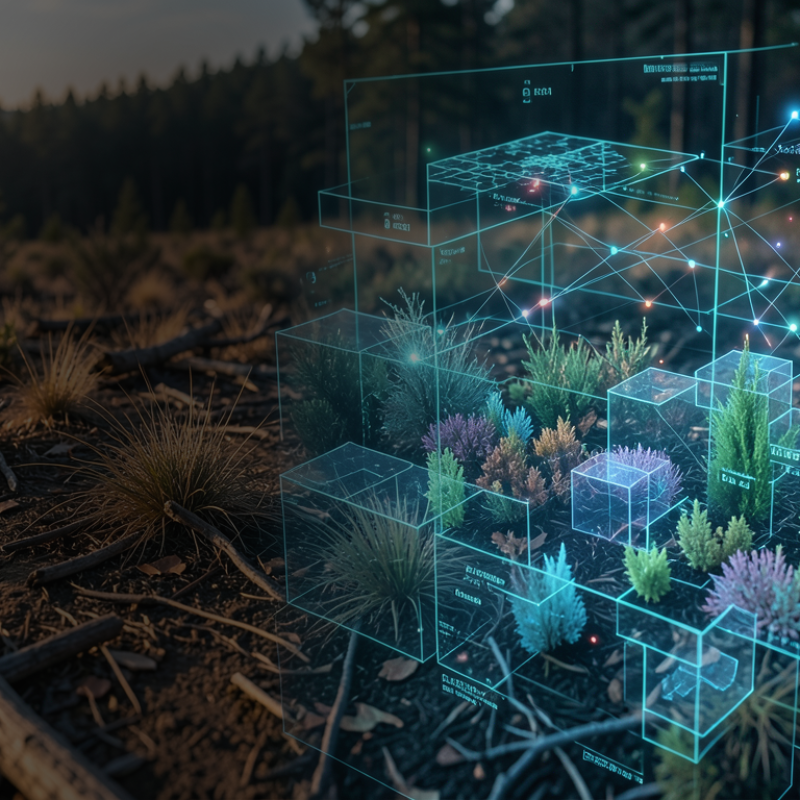
The Central Florida Tech Grove, in partnership with NAWCTSD and SERDP/ESTCP, is launching a prize challenge to identify proof of concept solutions for high resolution 3D mapping and modeling of surface fuels, understory vegetation, and near ground fuel structure. The challenge seeks innovative approaches that improve the development of realistic, spatially explicit fuels data for next generation wildfire and prescribed fire behavior modeling across complex landscapes and military lands.
Prize Challenge Information
Overview
The Central Florida Tech Grove, in partnership with the Naval Air Warfare Center Training Systems Division (NAWCTSD) and the Strategic Environmental Research and Development Program / Environmental Security Technology Certification Program (SERDP/ESTCP), is executing a prize challenge to identify innovative workflows, sensing technologies, and modeling approaches capable of generating realistic, meter scale 3D maps of ground, surface, and understory vegetation fuels. This challenge focuses on improving the characterization of fine scale vegetation structure and fuel properties including shrubs, grasses, litter, woody debris, and under canopy vegetation that are difficult to accurately capture using conventional remote sensing and fuels mapping approaches.
Participants are encouraged to develop scalable, validated methodologies that integrate advanced sensing technologies, data fusion, artificial intelligence, LiDAR, photogrammetry, voxel modeling, or other novel approaches to produce spatially explicit fuels data compatible with next generation fire behavior modeling systems such as QUIC Fire, FIRETEC, FDS, and FastFuels. Submissions should demonstrate operationally relevant workflows capable of generating fuel property datasets including loading, depth, live versus dead fuel composition, surface area to volume ratios, and 3D fuel distributions suitable for wildfire response, prescribed fire planning, and land management operations.
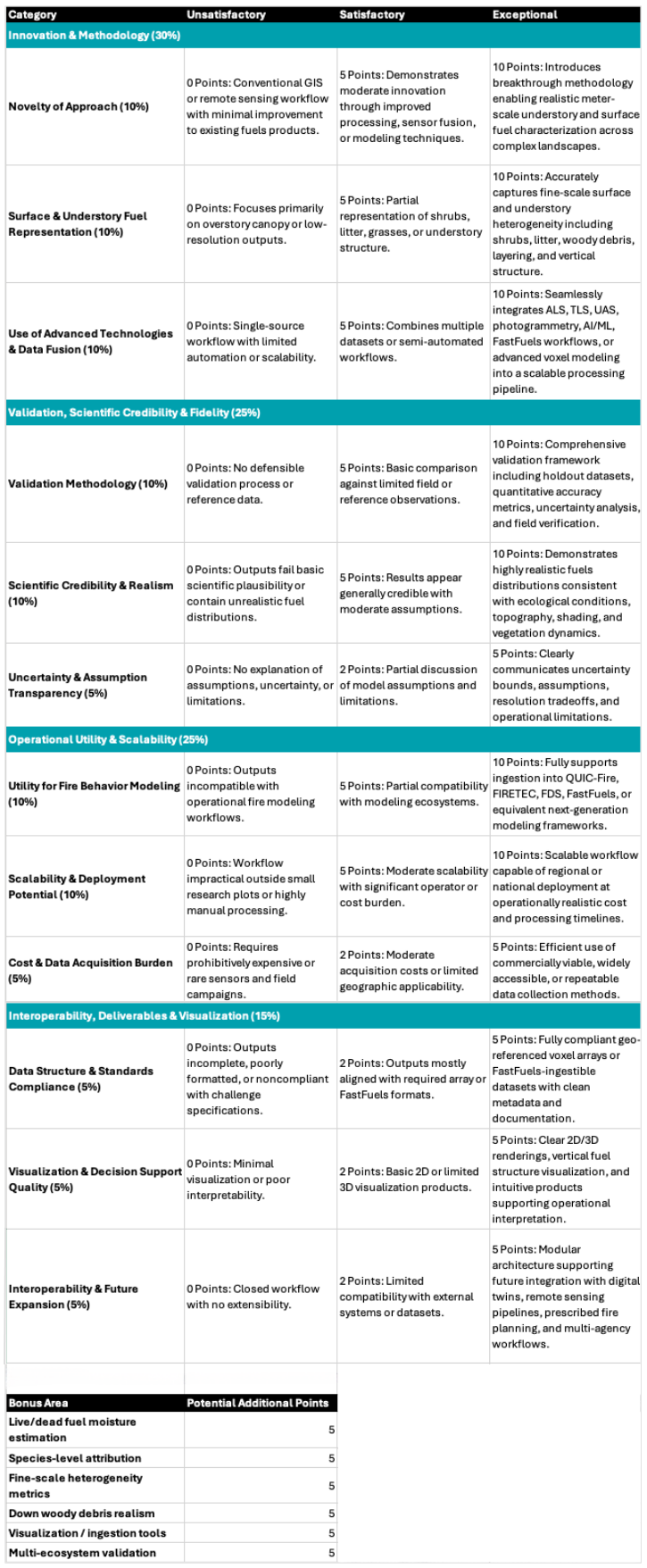
Submissions from all participants will be evaluated by subject matter experts (SMEs) from supporting DoD entities, wildfire science organizations, and partner agencies with expertise in remote sensing, vegetation modeling, wildfire behavior, and operational fire management. Evaluation will emphasize realism, scalability, interoperability, scientific credibility, and operational utility. Finalists will be selected based on technical merit, demonstrated capability, and the quality of delivered fuels datasets and visualization products.
Problem Statement
Wildland fire behavior is strongly influenced by the structure, composition, and distribution of surface and understory fuels. However, existing fuels products often lack the spatial fidelity necessary to accurately represent the fine scale heterogeneity of grasses, shrubs, litter, woody debris, and under canopy vegetation that drive fire spread and intensity in complex landscapes. Current operational mapping methods frequently rely on coarse classifications or generalized assumptions that do not adequately capture the three dimensional structure of fuels at meter scale resolution.
This limitation is especially significant on and near military lands, where prescribed fire and wildfire management decisions require increasingly accurate fuels characterization to support firefighter safety, ecosystem resilience, operational planning, and advanced fire behavior modeling. While technologies such as terrestrial LiDAR, drone photogrammetry, hyperspectral sensing, AI enabled segmentation, and voxel based modeling have demonstrated promise, there remains a critical need to identify scalable and operationally realistic workflows capable of generating scientifically credible fuels datasets across diverse ecosystems.
The 3D Surface Fuels & Vegetation Modeling Prize Challenge seeks innovative, validated solutions that measurably improve the generation of high resolution, spatially explicit fuels data for wildfire science, prescribed fire operations, and next generation fire modeling applications.
Prizes/Awards
Opportunities to collaborate with industry, government, and academic leaders and partners in wildfire science, environmental resilience, remote sensing, artificial intelligence, and advanced modeling technologies.
Potential exposure to Department of Defense stakeholders, wildfire science programs, and follow on innovation opportunities.
Timeline
- 6/3/26: Prize Challenge Release and application portal open on USA.gov and the Tech Grove Website.
- 6/10/26 10:00AM EDT: Virtual information session. Register for Virtual Information Session Here
- 6/12/26: Link to recording of the virtual information session and any additional materials provided to potential participants via the platform.
- 7/20/26 11:59PM EDT: Deadline for submission of solution prototypes, required documents, and sample output by 11:59 pm Eastern Time. Submissions must meet the requirements outlined in the Initial Submission Requirements.
- 7/28/26: Evaluation of submissions by SERDP and other DoD SMEs based on the technical requirements and stated judging criteria. Up to 10 semi-finalists will be selected for participation in the final Presentation/Demo Day.
- 8/4/26: Notification to semi-finalists of selection to participate in Presentation/Demo Day and instructions for submission of Demo Day materials.
- 8/12/26: Semi-finalists will submit all deliverables for Demo Day by 11:59 pm Eastern Time per instructions provided via email, meeting the Finals Submission Requirements.
- 8/20/26: Virtual Demo Day. Finalists will present their solutions, and three winners will be selected and announced to receive the $40,000, $25,000, and $20,100 prizes.
Prizes
$85,100
in total cash prizes
$40,000 awarded to the top finalist; $25,000 awarded to the second finalist; $20,100 awarded to the third finalist.
Additional Considerations-
- Exposure to leaders across Team Orlando and other branches of the U.S. Department of Defense (DoD) responsible for the development and deployment of training and operational solutions.
- Opportunities to learn from and collaborate with industry, government, and academic leaders and partners in the wildfire response space.
- Potential for follow-on opportunities such as Other Transaction Agreements (OTAs), Cooperative Research and Development Agreements (CRADAs), and others.
How to Enter
Prize Challenge officially launches on June 3rd, 2026.
All submissions must include the following:
End-state outputs (not raw sensor data, see specifications below) for one or more real world test areas with natural vegetation, along with geospatial locational data (e.g., boundary polygon as geojson with projection information). Areas mapped should be at least 100m x 100m, ideally larger (1km x 1km or larger) if possible; while only one such dataset is required, providing data from multiple sites is preferred to help illustrate generality of methods.
Submission packages should include:
- Georeferenced 3D fuels data (or FastFuels-compatible outputs)
- Fuel property maps and 3D visualizations
- Validation Documentation
- A Python-based visualization or ingestion tool
(See Judging Section for all specific submission requirements)
To join the challenge and submit your solution please use the link below:
Judging
Phase 1: Initial Submission and Evaluation
Participants will deliver the following by 11:59 pm Eastern Time on 7/20/26 via the designated process:
Entrants must provide End-state outputs (not raw sensor data, see specifications below) for one or more real world test areas with natural vegetation, along with geospatial locational data (e.g., boundary polygon as geojson with projection information). Areas mapped should be at least 100m x 100m, ideally larger (1km x 1km or larger) if possible; while only one such dataset is required, providing data from multiple sites is preferred to help illustrate generality of methods.
1. Required end-state output deliverables:
Data can be provided via two options:
1) following geo-referenced arrays criteria below, or
2) following guidance for ingestion through FastFuels (see Appendix 7, below), which offers a broader range of potential input formats.
Geo-referenced arrays data requirements
2. Additional Desired Outputs
Participants are encouraged to provide additional arrays with the following quantities with robust methods for deriving each value:
- Species and species mix percentage estimates when multiple in a cell
- Live fuel moisture content
- Dead fuel moisture content
- Separate arrays with quantities associated with each prevalent species
- Metrics describing the way dead and live fuels are mixed (e.g. is live grass relatively uniformly mixed with dead grass or pine needles or is it stratified or clumped somehow)
- Metrics describing the prevalent patterns of heterogeneity below 2 meter (e.g. clump sizes and distances between bunches or size of small shrubs and distance between them)
3. Validation and Fidelity Requirements
Every submission must include a defensible validation approach.
Minimum expectations:
- Explanation of how accuracy was evaluated.
- Description of reference or “truth” data (if any).
- Discussion of scale, resolution, and uncertainty.
- Evidence the results pass a basic scientific “smell test.” Preferred (but not required):
- Holdout data.
- Quantitative accuracy metrics.
- Comparison against field observations. It is a proof-of-capability challenge intended to:
- Surface viable data pipelines.
- Force realistic sensor + processing partnerships.
- Identify providers worth future OTA or programmatic engagement.
4. Evaluation Considerations
Judges will assess submissions using a rubric-style approach, emphasizing:
1. Utility of the demonstrated methodology
2. Generality of approach (is if site or ecosystem specific or can it be applied in a wide range of ecosystems)
3. Data acquisition challenges/cost if using data beyond widely available data sources
4. Clarity of methodology
5. Credibility of validation.
6. Relevance to surface and understory fuels.
7. Practical scalability. Most of these criteria revolve around the fact that challenge sponsors are looking for demonstration of methods for high-resolution fuels mapping that can be applied at reasonable cost in a wide range of ecosystems across the United States in order to support prescribed fire and wildfire decisions.
5. Leveraging existing resources
- Participants are encouraged to leverage existing measurement, modeling, and analysis tools and capabilities. Participants can combine original work with existing methods if such combinations leads to more accurate description of the fuels.
- For example, the DoW SERDP and ESTCP program has invested in the development of methodologies and workflow to assist in the processing of remote and in situ fuels data. Some of these capabilities are described in the appendix material and participants are free to reach out to investigators mentioned in this material.
- One key example of existing capability that can be leveraged to assist in processing or be used as an example of the generation of fuels data arrays is FastFuels. For example, FastFuels, which is described in appendix materials, includes tools to ingest various fuels information of various forms and produce the 3D arrays. A description of the kinds of data that FastFuels can ingest is given in the appendix.
6. Appendix: SERDP/ESTCP Existing Fuels Capabilities that can be leveraged
7. Appendix: Using Fast Fuels to Produce 3D Arrays.
FastFuels is collection of freely available and open-source software for generating, modifying, and exporting 3D fuels data to common next-generation fire modeling formats. The principal mechanism for interacting with FastFuels is the publicly available API. FastFuels is under continual development, and this challenge is designed to expand the capabilities of 3D fuel modeling in the beta release version 2 of the FastFuels API which is available through this url. Documentation including how-to-guides, tutorials, and walkthroughs for obtaining an API key, accessing the API, and common full workflows is available at the following url. Specific guides for working with the Accepted Data Paradigms in Section 3 are listed below. In addition, full technical reference documentation for the API is provided at the included url. Finally, to enable programmatic access to the API, there is a web application available to API users for the creation and management of API keys at the following url.
Options A/B:
Option C:
Option D:
Acceptable data formats for FastFuels are GeoJSON, geopackage, geotiff, netcdf.
Option A: 2D raster of surface and midstory fuel classification in a geotiff or netcdf format at up to 10-meter resolution
Option B: 2D raster of surface fuel properties in a geotiff or netcdf format at up to 10-meter resolution. Per fuel type priority quantities include:
Option C: 3D Voxelized fuels in netcdf format at up to 1 m 1 m x 1 m x 1m resolution. Per fuel type priority quantities includes:
Option D: Layersets describing statistical distributions of fuel types within a polygon in a GeoJSON or geopackage format. Per fuel type descriptors include:
This enables 3D fuel data engines such as Fast Fuels to:
1. Derive the appropriate model input metrics.
2. Voxelize fuels at the appropriate scale/resolution.
3. Integrate outputs into downstream fire models.
The method of collection is open. The output structure is not.
8. Sensors and Collection Methods (Open by Design)
The challenge is sensor-agnostic.
Examples of data sources that entrants may use:
- Terrestrial LiDAR.
- Mobile LiDAR.
- Drone Photogrammetry.
- Off the shelf cameras.
- Survey-grade scanners.
- SAR, multispectral, or hyperspectral data.
- Crowd-sourced or survey-company data.
Judging Criteria
Phase 2: Demo Day and Final Judging
The Prize Challenge Demo Day
The semi-finalists selected from Phase 1 of the competition will participate in a live field demonstration at the Central Florida Tech grove. All Demo Day teams will engage demonstrate their solutions and engage in potential one-on-one sessions with judges to determine final Prize Challenge winners.
Judging Criteria for Demo Day
Detailed judging criteria for Round 2 will be provided directly to all selected finalists following the down selection process to support their preparation for Demo Day.
Rules
Eligibility Requirements
Participants may be individuals or teams from industry, academia, state/local government, or non-profit entities. Eligibility is subject to verification during each Phase and before award of any prize. To be eligible to win, all individual participants or members of a participating team must meet the following eligibility requirements:
1. Participants must have complied with all requirements set forth in the prize challenge.
2. All individuals must be at least 18 years of age and a citizen of either the United States or a United States ally (NATO-affiliated country).
3. Except for employees appointed under the STEM Student Employment Program or other student employment programs, Federal employees and support service contractors are not eligible to participate.
4. Participants may not use Federal funds to support participation.
Rules:
SERDP reserves the right to cancel, suspend, and/or modify the Challenge, or any part of it, for any reason, at their sole discretion.
Terms and Conditions
Representations:
Upon submission, the Participant hereby represents and warrants that:
- It is the sole author and copyright owner of the submission; that the submission is an original work of the Participant and that the Participant has sufficient rights to use and authorize others, including SERDP, Tech Grove, NAWCTSD, and the Navy, to use the submission as specified in the Official Rules; that the submission does not infringe upon any copyright or upon any other third-party rights; and that the submission is free of malware.
- The submission, and any use thereof by the Central Florida Tech Grove, NAWCTSD, or the Navy, is not defamatory or libelous in any manner; does not constitute or result in any misappropriation or other violation of the publicity rights or right of privacy of any person or entity; and does not infringe, misappropriate, or otherwise violate any intellectual property rights, privacy rights, or other rights of any person or entity.
- It is free to enter into this challenge without the consent of any third party.
- There is no suit, proceeding, or any other claim pending or threatened against the Participant that could limit or impair the Participant's performance of its obligations pursuant to these Terms and Conditions.
- It will not infringe, violate, or interfere with the intellectual property, publicity, privacy, contract, or other right of any third party in the course of performance of this agreement or cause NAWCTSD or the Navy to do any of the same.
- It will comply with all applicable laws, rules, and regulations in performing under these Terms and Conditions.
- It otherwise meets the eligibility requirements set forth by the prize challenge.
Data Rights and Marking
- All data submitted under the Prize Challenge will be made available to the Central Florida Tech Grove, NAWCTSD, and parties authorized to act on behalf of NAWCTSD. By accepting these Terms and Conditions, the Participant consents to the use of all submitted data by NAWCTSD.
- The use of protective markings such as "Do Not Publicly Release — Trade Secret" or "Do Not Publicly Release — Confidential Proprietary Business Information" is authorized. Participants should be aware that any information received is considered a federal agency record and may be subject to release under the Freedom of Information Act (FOIA), 5 U.S.C. §552. Participants will be notified of any FOIA requests for their submissions in accordance with 32 C.F.R. § 286.10.
Relationship of the Parties
- Nothing contained in these Terms and Conditions is intended to create or constitute a relationship between SERDP, Tech Grove, or NAWCTSD and a Participant. Participation in the Prize Challenge does not imply any form of sanction, endorsement, or support of the Participant by SERDP, Tech Grove, or NAWCTSD, nor does it grant either party any authority to act as agent for the other. A Participant may not use a SERDP, Tech Grove, NAWCTSD, or Department of Defense logo or official seal in their submission.
Participant Liability and Insurance
- All Participants agree to assume any and all risks of injury or loss in connection with or arising from participation in this challenge, or development of any submission. Except in the case of willful misconduct, all Participants waive and release any and all claims or causes of action against the Federal Government and its officers, employees, and agents for any injury or damage of any nature whatsoever arising from their participation in the challenge.
- Based on the subject matter of the prize challenge and the type of work involved, no individual or entity participating in the prize challenge is required to obtain liability insurance or demonstrate financial responsibility in order to participate.
Disputes
- Participation constitutes each Participant's full and unconditional agreement to these Official Rules and Terms and Conditions, which are final and binding in all matters related to the challenge. The final scores and determinations of the Judging Panel are final and binding on all Participants and may not be challenged.
Background Information
Follow-On Activities
This Open Call Announcement is considered to have potential for further efforts that may be accomplished via FAR-based contracting instruments, Other Transaction Authority (OTA) for Prototype Projects 10 USC 4022 and Research 10 USC 4021, Prizes for advanced technology achievements 10 USC 4025, and/or Prize Competitions 15 USC 3719. If a prototype OTA is awarded and considered successfully completed, follow-on production may be pursued in accordance with 10 USC 4022(f). The public open call announcement made at https://www.challenge.gov/ is considered to satisfy the reasonable effort to obtain competition in accordance with 10 USC 4025(b), 15 USC 3719(e) and 10 USC 4022(b)(2). Any FAR-based actions will follow announcement procedures per FAR 5.201(b) accordingly.
Intellectual Property Considerations
By participating in this competition and submitting in any of the rounds, participants are granting the US Government and its Partners permanent access to the provided prototypes, documents, and materials, with the provision that the US Government and its Partners may store and copy the documents in perpetuity. Participants will retain intellectual ownership of and publishing rights.
Excluding any material considered to be co-produced with the US Government, the US Government and its Partners agree not to share submissions with other entities, including files and tradecraft concepts.
About the Central Florida Tech Grove
The Central Florida Tech Grove is a Department of Defense innovation hub established in 2020 under a Partnership Intermediary Agreement between the Naval Air Warfare Center Training Systems Division and the University of Central Florida Research Foundation. The Tech Grove was founded as a multi-service innovation hub with funding from the Navy, Army, Air Force, and Marine Corps training commands as well as the Office of Naval Research and the Office of the Secretary of Defense. With a three-pronged mission to (1) grow the defense industry base, (2) facilitate technology transfer and transition, and (3) solve problems, the Tech Grove executes a wide range of initiatives that bring together entrepreneurs, industry, academia, and government from across the United States and internationally to develop innovative solutions for military human performance. www.centralfloridatechgrove.org
About the Strategic Environmental Research and Development Program (SERDP)
SERDP and ESTCP fund resilience, restoration, natural hazard adaptation, and conservation projects that enhance capabilities and sustain operations at Department of Defense (DoD) installations. Their science and technologies protect built and natural infrastructure, strengthen the defense supply chain, and ensure the health and safety of our warfighters. Over the past 10 years, SERDP's Wildland Fire Science Initiative has led innovation of advanced tools and technology to improve safe and effective prescribed fire, improved wildfire response, and advanced training capabilities for wildland firefighters. www.serdp-estcp.org
About Naval Air Warfare Center Training Systems Division (NAWCTSD)
The Naval Air Warfare Center Training Systems Division (NAWCTSD) is the principal Navy center for research, development, test and evaluation, acquisition, and product support of training systems. NAWCTSD provides inter-service coordination and training systems support for the Army, Marine Corps, and Air Force. NAWCTSD is a foundational member of Team Orlando, a unique collaborative with training and simulation divisions of the Army, Marine Corps, Air Force, and Space Force, as well as academia and key supporting economic development organizations. www.navair.navy.mil/nawctsd
Satisfying Competition Requirements: Other Transaction Authority:
This competition public announcement is an open call to small businesses and non-traditional defense contractors seeking innovative, commercial technologies proposed to create new DoD solutions or potential new capabilities fulfilling requirements, closing capability gaps, or providing potential technological advancements—technologies fueled by commercial or strategic investment, as well as concept demonstrations, pilots, and agile development activities improving commercial technologies, existing Government-owned capabilities, or concepts for broad Defense application(s). As such, the Government reserves the right to award a contract or an Other Transaction for any purpose, to include a prototype or research, under this public announcement. The Federal Government is not responsible for any monies expended by the applicant before award and is under no obligation to pursue such Other Transactions.
Additional Links & Resources
Find additional resources, documents, and FAQ to assist with Prize Challenge participation.
3D Surface Fuels & Vegetation Modeling Prize Challenge Virtual Information Session
FAQ
1. What is the preferred submission format?
See the Judging Tab to view all submission information and requirements.
2. Where exactly should completed submissions be sent?
Click the "Join the Challenge" button on this page and fill out the submission form to complete your application.
3. Is there a recorded information session available for the current Prize Challenge?
Yes. The Live recording will be made available by June 12th, 2026
Have a Prize Challenge Question?
Reach out to our team by completing the form below.

© Copyright Central Florida Tech Grove. All Rights Reserved
OptimizePress Popup Overlay

Prize Challenge Dates & Details
Official Challenge Launch
June 3rd, 2026
Official Prize Challenge Kickoff for all participants
Virtual Info Session
June 10th, 2026, 10:00AM EST
Learn more about the Prize Challenge process and engage in Q&A
Submissions Deadline
July 20th, 2026, 11:59PM EST
Last day to submit your Prize Challenge solution
Total Cash Prizes
$85,100
1st Place: $40K, 2nd Place: $25K, 3rd Place: $20,100K