
Defense Advanced Research Projects Agency (DARPA)
Documentation and Decision Support Sprint (D2)
The DARPA Documentation and Decision Support Sprint (D2) is a virtual Sprint designed to catalyze advancements in combat medicine through targeted prize incentives, specifically seeking autonomous solutions that enable hands-free DD Form 1380 documentation and Tactical Combat Casualty Care (TCCC)-aligned decision support.

Prize Sprint Information
Overview
The DARPA Documentation and Decision Support Sprint (D2) will rapidly accelerate the delivery of autonomous documentation and decision support for untrained persons to deliver tactical combat casualty care using passive sensor data. The Sprint operates as a virtual Sprint centered around a six-month algorithm development period. Following this development phase, teams will submit their algorithms for an evaluation round, demonstrating their ability to establish the State of the Art (SOA) across two distinct lanes: Triage Documentation and Decision Support, all competitors should expect to compete in both lanes.
Competing teams will be provided Government Furnished Information (GFI) in the form of representative data sets from tactical combat casualty care scenarios, including audio, video, and accelerometry data from the first approximately 20 minutes of care rendered to simulated casualties by medics for training algorithms.
The entire Sprint will be conducted virtually, with teams downloading the de-identified datasets to develop and run solutions entirely on their own systems. The event will ultimately culminate in a hybrid awards ceremony in the DC area to recognize the top-performing solutions.
At the conclusion of the development period, teams will be rigorously evaluated by Independent Verification and Validation (IV&V) partners. Submissions will be tested against a held-back portion of the dataset and scored based on key metrics including overall accuracy, documentation completeness, and usability.
To reward the most effective high-risk, high-reward innovations, the D2 features a $1,000,000 total prize pool.
Timeline
- September 11, 2026: Public announcement of the Documentation and Decision Support Sprint and for the release of the Prize Sprint via Tech Grove website, email campaigns, and other information distribution channels.
- September 11, 2026: Prize Sprint Release and application portal open on the Tech Grove Website.
- September 11, 2026 – December 1, 2026: Sprint Qualification window is open and will be evaluating proposals and accepting Sprint competitor teams on a rolling basis.
- September 22, 2026: 1hour Virtual Industry Day
- December 1, 2026: Sprint Qualification window closes.
- March 1, 2027: Teams submit final algorithm package for evaluation.
- March 26, 2027: Hybrid awards ceremony. Prize winners will be announced at the awards ceremony.
Benefits of Participating
$1,000,000
in total cash prizes
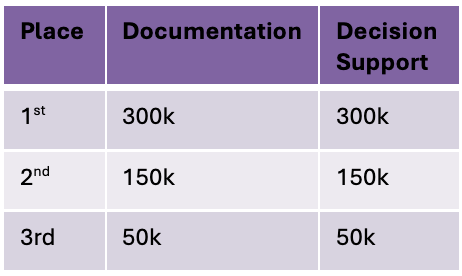
There will a total of $1M in prizes distributed across the two lanes. $300,000 for first place, $150,000 for second place, and $50,000 for third place.
Additional Considerations-
- Exposure to leaders in autonomy development and branches of the U.S. Department of Defense (DoD) responsible for acquisition of development and deployment of training solutions.
- Opportunities to learn from and collaborate with other industry, government, and academic leaders and partners in this space.
Eligibility
Registration Eligibility
The DARPA Documentation and Decision Support Sprint (D2) is open to individuals and team members who have applied for the D2 Sprint and meet the eligibility requirements:
- Application and participation is open to individuals who are U.S. citizens or U.S. permanent residents (Green Card holders), representing only U.S. entities (e.g., companies, academic institutions), and government employees (civilian and military).
Non-U.S. individuals and organizations may participate as team members but must have a U.S. citizen or permanent resident as the applicant and team representative.
- All participants under 18 years of age require parental or guardian authorization.
An individual, organization, or sponsor is not eligible to apply or participate if they are on the Specially Designated Nationals list.
- U.S. Government organizations and FFRDCs may participate in D2C but are not eligible for prizes. To the extent there is a limit on the number of participating teams, the participation by Government organizations will not prevent non-federal entities from participating in the Challenge. Government organizations that plan to participate in the D2C in any manner are encouraged to reach out to DARPA for clarification on these Terms.
DARPA employees and support contractors, their spouses, dependents, and household members are not eligible to participate.
- Federal employees and contractors acting outside the scope of their employment should consult their ethics official and appropriate management before participating in D2C. DARPA reserves the right to disqualify a participant whose actions are deemed to violate the spirit of the competition for any reason, including but not limited to, the violation of relevant laws or regulations in the course of participation in the Challenge.
To be eligible to win a prize in the Competition, each team must have registered to participate in the Competition in accordance with the instructions outlined herein.
- Verifying Eligibility: DARPA reserves the right to verify your eligibility and to adjudicate on any dispute at any time. You agree to provide DARPA with any proof of eligibility requested by DARPA and your refusal or failure to provide such proof within 10 days of DARPA’s request will result in your disqualification from the Challenge and forfeiture of any prizes.
Non-U.S. individuals and organizations may participate as team members but must have a U.S. citizen or permanent resident as the applicant and team representative.
An individual, organization, or sponsor is not eligible to apply or participate if they are on the Specially Designated Nationals list.
DARPA employees and support contractors, their spouses, dependents, and household members are not eligible to participate.
To be eligible to win a prize in the Competition, each team must have registered to participate in the Competition in accordance with the instructions outlined herein.
Award Eligibility
- The D2 prizes are authorized under 15 U.S.C. § 3719, subject to the availability of appropriated funds for which the payment for prize purposes can be made. The Government reserves the right to withhold prizes to ineligible and disqualified participants. Tax treatment of prizes will be handled in accordance with U.S. Internal Revenue Service guidelines.
- To receive a monetary prize, participants must provide a U.S. social security or taxpayer identification number (TIN). Information on how to obtain a TIN is available on the U.S. Internal Revenue Service website at www.IRS.gov. Foreign nationals will be subject to the U.S. and local tax codes applied to prize awards.
- The Government reserves the right to withhold prizes to ineligible and disqualified individuals.
- To receive a monetary prize, the team representative collecting the prize must be a U.S. citizen or permanent resident.
Disqualifications
You may be disqualified from the Competition and forfeit any prizes you may be eligible to receive if DARPA reasonably believes that you have attempted to undermine the legitimate operation of the Competition, including:
- Providing false information about yourself during registration or concerning your eligibility;
- Breaching or refusing to comply with these Terms;
- Tampering or interfering with the administration of the Sprint or with the ability of other participants to participate in the Sprint;
- Determinations that you have failed to comply with the Challenge Guidelines and/or Rules;
- Submitting content that:
- violates the rights of a third party; or
- is lewd, obscene, pornographic, racist, sexist, or otherwise inappropriate to the Sprint; or
- violates any applicable law; or
- violates the U.S. Department of Defense Social Media User Agreement at https://www.dodig.mil/Disclaimers/Social-Media-User-Agreement/ (the "Agreement").
- Using discussion forums connected with the Challenge constitutes your agreement to comply with the Agreement.
- Threatening or harassing other participants or DARPA, including their employees and representatives. Harassing behavior includes: offensive, threatening, and/or hateful comments directed toward an individual or protected class (gender, sexual orientation, disability, gender identity, age, race, religion, ethnicity, or veteran status), the use or display of sexual images in public spaces, deliberate intimidation, stalking, following, taking unwelcome photos/videos, sustained disruption of talks or other events, inappropriate physical contact, unwelcome sexual attention, and developing and/or promoting any applications designed to encourage any of these behaviors.
- Reporting: You may report to DARPA any harassment, cheating, or violation of these Terms by another participant. DARPA may investigate any such allegations and all decisions by DARPA in these matters are final and binding. If you are asked to stop any harassing behavior, you are expected to comply immediately.
- The Government reserves the right to disqualify any individual or organization that brings discredit to the Government or whose actions could reasonably be expected to do so. This includes associations with an organization that might bring discredit to the Government.
For complete details regarding eligibility, competition rules, and official Terms & Conditions, please visit the official DARPA Competition Website
How to Enter
There is a two-part process to qualification. First, teams must submit a Narrative Description of their technical approach to the portal
DARPA will use the description to evaluate the team’s overall approach and potentially inform additional follow-up questions and/or tasks. Teams selected from Part 1 will receive a Part 2 Qualification Task involving non-HSR data.
Qualification submissions will be reviewed on a rolling basis. Teams can expect an update on their qualification status within 10 business days of completing a submission to Part 1 or Part 2 of the qualification. Teams are encouraged to submit their materials well in advance of the qualification deadlines. DARPA may request additional information or a teleconference with a team to discuss their submitted materials. Teams that successfully pass part 1 of the qualification will be given access to the training dataset necessary for part 2. At the end of the qualification period, DARPA will finalize the selection of up to a maximum of 20 qualified teams. Final selection will be determined by the technical merit of the approach from Part 1 and objective performance evaluation metrics from the Part 2 Qualification Task.
Narrative Description
The narrative description must include the following sections:
1. Team Information
- Team Name
- Team Organization
- Team Point-of-Contact (name, email, phone number, address)
- Team Roster, list of all team members, their affiliations and email. If foreign nationals are members of the team, please specify here.
2. Technical Approach (500 words max per subsection)
A. Experience
- Note any relevant experience in algorithm development, human subjects research, working with the government
B. Workflow for handling large volumes of video data and incomplete data
- Describe your methods for annotating video data
- Describe your methods for handling incomplete datasets
C. Algorithm development
- Describe your proposed high-level software architecture
- Describe any existing software that will be used to develop algorithms
D. Algorithm training methods
- Discuss your intended training methods and what if any additional (non-HSR) data you intend to use
E. Transition and commercialization plans
- Outline your planned transition and/or commercialization strategies post-Sprint
For each element of the Technical Approach, DARPA will assess whether the plan is consistent with the rules and can successfully compete in D2.
3. Supplemental Information: DARPA encourages submissions that also include additional evidence of ability in this domain. Teams may choose to upload a PDF of additional information regarding their capabilities.
4. Data Handling Agreement and Safeguarding
To participate in this Sprint, performers must adhere to the following limited-use principles for the DARPA-provided dataset (classified as Non-Attributed Technical Sensor Data; contains no Personal Health Information or real casualties):
- Permissible Use & Downloading: You are authorized to download the DARPA-provided dataset to your own systems solely for local development and training of automated medical documentation and decision support algorithms. You must not share, copy, or distribute this data to unauthorized third parties or use it outside this research scope.
- No Re-Identification: Do not attempt to deduce, infer, or uncover the real-world identities of any individual persons in the DARPA-provided dataset.
- No Facial Recognition: Do not run the DARPA-provided dataset against any facial recognition, social media, or reverse-image search engines.
- Algorithmic Isolation: Use facial data strictly as an anonymous physiological sensor input. Do not train, tune, or use models for identity verification, profiling, or biometric surveillance.
- Enforcement: Any violation of these terms will result in immediate disqualification from the Sprint, forfeiture of associated funding, and potential contractual or legal action.
Qualification Task
In this qualification task, submitted algorithms will be required to detect injuries from images of simulated casualties (non-HSR data). Teams will receive a training dataset consisting of high-resolution photos of medical manikins displaying various traumatic injuries. Submitted algorithms will be required to process a set of images similar to the training data to locate and classify the injury state of upper and lower extremities. Accurate performance relies on correctly identifying the injury class and injury location relative to the casualty's actual anatomical left or right side, rather than the camera's perspective.
4.2.1 Qualification Task Injury Classes
The following injury classes will be used in this task:
- No injury: No visible injury; the limb is intact and healthy.
- Wound: Visible trauma present (e.g., severe lacerations, burns, shrapnel wounds,
- compound fractures) but the limb is still anatomically attached.
- Amputation: The limb is completely severed.
- Not Testable: Limbs are not visible in the image.
Teams must submit their finalized algorithm packaged within a Docker container. This container will be executed in an isolated computer against a held-back validation set of photos. The submission output will be a JavaScript Object Notation (JSON) file containing each limb and injury state for each casualty photo. Further details on the specifics of submission can be found in the Qualification Task Interface Control Document (ICD).
4.2.2 Qualification Task Evaluation Metrics
Teams will be evaluated on how accurately their models classify the injury status at each of four body sites: the left and right lower and upper extremities.
Overall accuracy will be defined as follows:
Overall Accuracy=(correct class-at-site predictions)/(all class-at-site predictions)
Alongside accuracy, DARPA will consider additional machine learning performance metrics to provide a more comprehensive evaluation of team approaches and model performance.
Judging/Evaluation Metrics
Lane 1: Triage Documentation
The first lane focuses on the documentation of the DD1380. The DD1380 contains fields for documenting current casualty status as well as Life Saving Interventions (LSIs) applied to the casualty. The ability to autonomously identify casualty status and treatments is expected to be a necessary first step to performing well on Lane 2. All information needed for developing the algorithms can be found in the provided datasets.
Scoring - This lane measures overall accuracy in completing the DD1380. The score is the number of correct assessments relative to the total number of assessments. The score is an integer between 0 and 100, where 100 indicates 100% accurate and complete assessments.
Lane 2: Decision Support
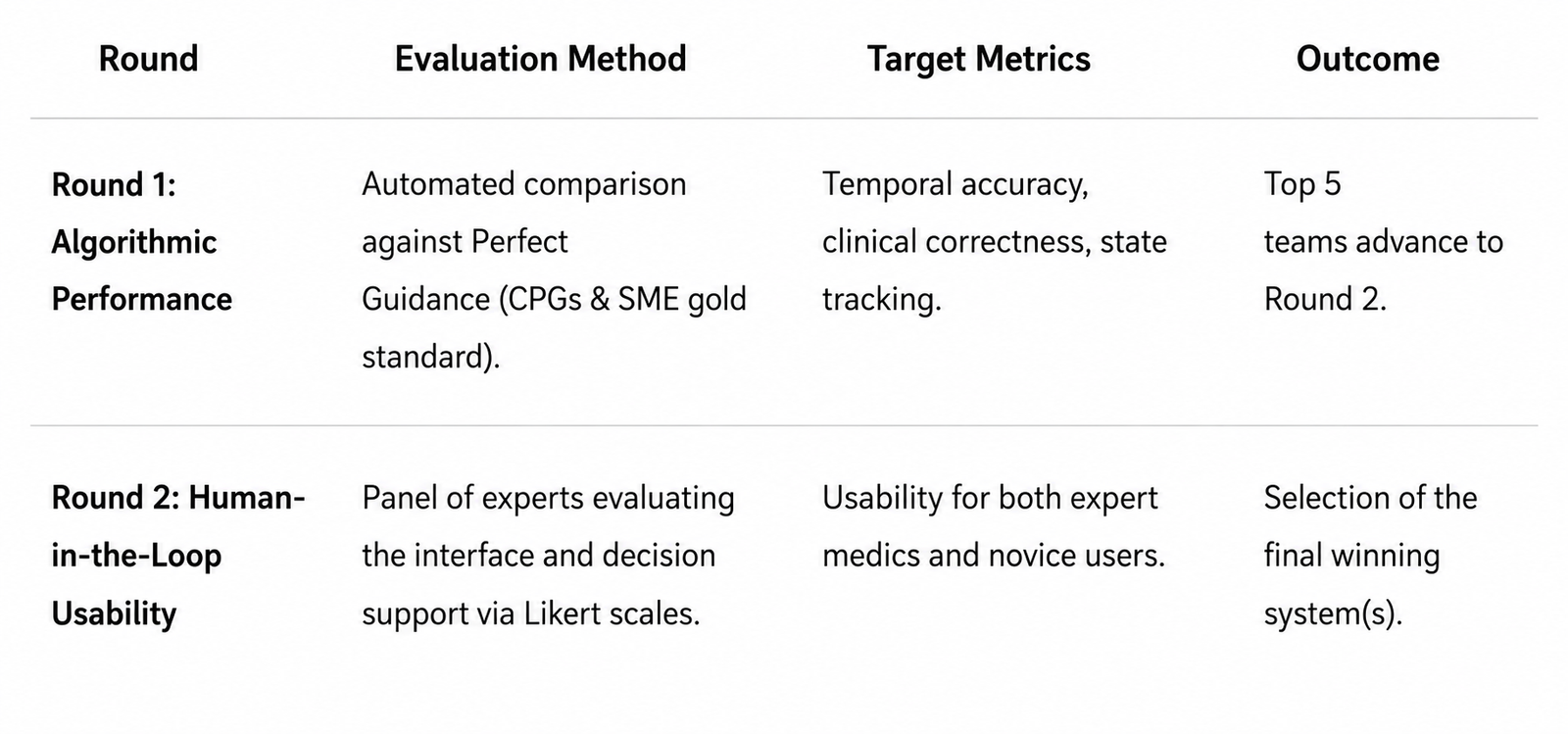
Lane 2 takes the next step after documentation to provide verbal, time-synced guidance on treatment steps to medics and untrained users. This lane is expected to be more difficult, as teams must synthesize correct steps based on TCCC and CPG documentation rather than relying solely on provided annotations.
The scoring process is structured into two distinct rounds to evaluate both objective algorithmic accuracy and subjective operational utility.
Terms and Conditions
Ownership, Rights in Your Submissions, Sharing
- By participating in this competition and submitting in any of the rounds, participants are granting the US Government and its Partners permanent access to the provided software prototypes and documents with the provision that the US Government and its Partners may store and copy the documents in perpetuity. Participants will retain intellectual ownership of and publishing rights. Excluding any material considered to be co-produced with the US Government, the US Government and its Partners agree not to share submissions with other entities, including files and tradecraft concepts.
- DARPA will not disclose the technical briefs or code bases submitted by participants outside the Government except where this information is handled by DARPA support contractors for administrative purposes and/or to assist with technical evaluation. All DARPA support contractors performing this role are bound by nondisclosure agreements.
- Sharing Your Information: Government-funded and self-funded teams may be featured on the D2 website. We will not disclose your contact information if you do not wish to share it with the public. Photos and text descriptions of Sprint events may be posted on the DSC and other DARPA-affiliated social media sites.
Government Furnished Information (GFI)
Competitor teams qualified to participate in D2 will be able to download, for the limited purpose of the competition the following datasets:
- DARPA Triage Challenge (DTC) Dataset; jointly owned by DARPA and the Army,
- Automating Documentation (AutoDoc) Dataset; owned and developed by the United States Army Institute of Surgical Reseach (ISR)
- DARPA Medical Intelligent Network for Evaluation, Readiness, Validation, and Analysis (MINERVA) Dataset; owned by DARPA
To participate in this Sprint, performers must adhere to the following limited-use principles for the DARPA-provided datasets (classified as Non-Attributed Technical Sensor Data; contains no Personal Health Information or real casualties):
- Permissible Use & Downloading: You are authorized to download the DARPA-provided dataset to your own systems solely for local development and training of automated medical documentation and decision support algorithms. You must not share, copy, or distribute this data to unauthorized third parties or use it outside this research scope.
- No Re-Identification: Do not attempt to deduce, infer, or uncover the real-world identities of any individual persons in the DARPA-provided dataset.
- No Facial Recognition: Do not run the DARPA-provided dataset against any facial recognition, social media, or reverse-image search engines.
- Algorithmic Isolation: Use facial data strictly as an anonymous physiological sensor input. Do not train, tune, or use models for identity verification, profiling, or biometric surveillance.
- Enforcement: Any violation of these terms will result in immediate disqualification from the challenge, forfeiture of associated funding, and potential contractual or legal action.
Organizational Conflicts of Interest
DARPA is committed to ensuring fairness to all competitor teams. To avoid organizational conflicts of interest (OCI)1 or the appearance of OCI, all D2 competitor teams with access to relevant data collected for the D2 must submit an OCI mitigation plan2. DARPA will review all OCI mitigation plans. DARPA has sole discretion to determine whether an OCI mitigation plan is sufficient to avoid, neutralize, or mitigate an OCI. DARPA may disqualify competitors with an OCI.
1.OCI definition
An “OCI” means that because of other activities or relationships with other persons, a person is unable or potentially unable to render impartial assistance or advice to the Government, or the person’s objectivity in performing the contract work is or might be otherwise impaired, or a person has an unfair competitive advantage. The three types of OCIs are biased ground rules, unequal access to information, and impaired objectivity.
2. OCI mitigation plan
In the case of an OCI or the appearance of an OCI, an OCI mitigation plan must be submitted to demonstrate
1. measures to firewall individuals in the organization(s) in questions; and
2. measures to firewall D2 data from the individuals who would participate in the D2 Sprint. DARPA will evaluate the adequacy of these measures to determine if the proposed measures sufficiently avoid, neutralize, or mitigate the OCI. An OCI mitigation plan that does not avoid, neutralize, or mitigate an OCI may result in disqualification from the competition. DARPA has sole discretion to disqualify any competitors.
Additional Information
Questions regarding rules should be sent to D2Sprint@darpa.mil
DARPA may modify the rules in writing at any time and for any reason, including the accommodation of a promising technical approach that would have been excluded by the rules.
DARPA unilaterally reserves the right to cancel or modify the Sprint at its sole discretion. All participants in the Sprint shall sign, as part of the registration process, the Event Participation Agreements.
Disputes
Participation constitutes each Participant's full and unconditional agreement to these Official Rules and Terms and Conditions, which are final and binding in all matters related to the Sprint. The final scores and determinations are final and binding on all Participants. The final scores of the Judging Panel and the final determination of all Winners may not be challenged by the Participants.
For complete details regarding eligibility, competition rules, and official Terms & Conditions, please visit the official DARPA Competition Website
Background Information
About the Defense Advanced Research Projects Agency (DARPA)
The Defense Advanced Research Projects Agency (DARPA) is an independent research and development agency within the U.S. Department of War (DoW). Created in response to the launch of Sputnik in 1957, DARPA stands as the nation’s commitment to never again face a strategic technical surprise. Working with innovators inside and outside government, the agency has delivered on its mission many times over – transforming the seemingly impossible into world-changing defense and national security capabilities. Often, DARPA innovations also become fixtures of modern civilian life. Unlike other agencies, DARPA is not satisfied with incremental advances. It pushes transformational breakthroughs – innovations that not only solve current challenges but also establish the U.S. as the leading driver of strategic technological invention.
About Naval Air Warfare Center Training Systems Division (NAWCTSD)
The Naval Air Warfare Center Training Systems Division (NAWCTSD) is the principal Navy center for research, development, test and evaluation, acquisition, and product support of training systems. NAWCTSD provides inter-service coordination, and training systems support for the Army, Marine Corps, and Air Force. NAWCTSD is a foundational member of Team Orlando, a unique collaborative with training and simulation divisions of the Army, Marine Corps, Air Force, and Space Force, as well as academia and key supporting economic development organizations. www.navair.navy.mil/nawctsd
About the Central Florida Tech Grove
The Central Florida Tech Grove is a Department of Defense innovation hub established in 2020 under a Partnership Intermediary Agreement between the Naval Air Warfare Center Training Systems Division and the University of Central Florida Research Foundation. The Tech Grove was founded as a multi-service innovation hub with funding from the Navy, Army, Air Force, and Marine Corps training commands as well as the Office of Naval Research and the Office of the Secretary of Defense. With a three-pronged mission to (1) grow the defense industry base, (2) facilitate technology transfer and transition, and (3) solve problems, the Tech Grove executes a wide range of initiatives that bring together entrepreneurs, industry, academia, and government from across the United States and internationally to develop innovative solutions for military human performance. www.centralfloridatechgrove.org
Additional Links & Resources
For complete details regarding eligibility, competition rules, and official Terms & Conditions, please visit the official DARPA Competition Website
Have a Prize Competition Question?
For Rules and Technical Prize Competition Questions please contact the DARPA D2C team at: D2Sprint@darpa.mil
For all other Questions please reach out to the Central Florida Tech Grove Team at TechGrove@UCF.edu

© Copyright Central Florida Tech Grove. All Rights Reserved
OptimizePress Popup Overlay
Prize Sprint Dates & Details
Official Sprint Launch
September 11th, 2026
Official Prize Sprint Kickoff for all participants
Virtual Industry Day
September 22nd, 2026
Submissions Deadline
December 1st, 2026
Sprint Qualification Window Closes
Total Cash Prizes
$1,000,000
Documentation: 1st Place: $300K, 2nd Place: $150K, 3rd Place: $50K
Decisions Support: 1st Place: $300K, 2nd Place: $150K, 3rd Place: $50K