
Army CPE ST3
Army Training Verse Innovation Prize Challenge
The Army CPE ST3 (Capability Program Executive for Simulation, Training, Test & Threat) is launching a prize challenge to accelerate the development of the Digital Enterprise Engineering Environment (DE3), also known as the Army Training Verse. This challenge seeks innovative commercial and emerging solutions that advance an integrated, AI-enabled Modeling and Simulation enterprise through technologies and services such as enterprise platforms, data and model marketplaces, AI/ML operations, digital engineering tools, and collaborative decision support capabilities.
Prize Challenge Information
Overview
The Army CPE ST3 (Capability Program Executive for Simulation, Training, Test & Threat) is launching a prize challenge to accelerate the development of a Digital Enterprise Engineering Environment (DE3), also referred to as the “Army Training Verse.” DE3 aims to establish an integrated, data-driven, AI-enabled Modeling and Simulation (M&S) enterprise that empowers rapid decision making, design implementation, and capability delivery. The initiative seeks innovative commercial and emerging concepts, architectures, tools, and services that enable enterprise platform services, model marketplaces, onboarding assistance, data translation, algorithm repurposing, software/data cataloging, 3D model rendering, AI modeling & MLOps, chat/interaction layers, and model/data playbooks. This prize competition is conducted under the Government’s prize authority [10 U.S.C. § 4025 (Prizes for advanced technology achievements) and 15 U.S.C. § 3719] and is governed by the Official Rules, which are incorporated by reference; submitting an entry constitutes acceptance of the Official Rules. A consolidated acronym list and glossary of key terms – including MLOps (Machine Learning Operations) and definitions of “Army Training Verse” and “marketplace” – will be provided in the Official Rules.
The DE3 / Army Training Verse construct envisions a persistent simulation ecosystem with cloud-based access, access at the Point of Need (PoN), minimum instrumentation infrastructure, and support for Joint simulation interoperability and replication of weapon effects. The ecosystem is intended to facilitate the integration of simulation engines, support sensor fusion, provide an app store and game/scenario store, provide access to synthetic models and digital content/development platforms, facilitate 3D graphics/rendering, offer an AI agents/bots store, and provide access to a standards library using a marketplace approach -- leveraging commercial simulation products, digital/AI-enabled After Action Review (AAR), optimized scenario generation, and kinetic/non-kinetic threat replication to enable realistic training for Soldiers at the tactical edge.
This Army Training Verse Innovation Challenge is a multi-phased competition designed to accelerate the development of a Digital Engineering Enterprise Environment that supports the entire acquisition lifecycle. We seek to leverage commercial technology and modern open standards to create a versatile and intelligent simulation environment. The challenge is structured in a series of progressively complex stages, each with a corresponding prize amount, to incrementally build and test the platform’s capabilities.
Problem Statement
Today’s Army Digital Engineering (DE) and Modeling and Simulation (M&S) efforts often struggle to scale across portfolios due to fragmentation in tooling, data formats, and repositories - limiting reuse, slowing integration, and increasing the time and cost required to translate engineering artifacts into training- and mission-relevant simulations. The Army Training Verse / DE3 vision requires an enterprise approach: a centralized digital platform (and marketplace) that can store and manage simulation model data, Digital Engineering services, DevSecOps toolsets, and CAD files; connect to external digital environments via established/open APIs; and reliably exchange critical artifacts, such as CAD files, parametric simulation data, and SysML v2.0.
Beyond storage and connectivity, DE3 must enable an intelligent simulation pipeline that uses commercial technology and modern open standards to convert DE data into operationally relevant simulation environments, including military simulations (e.g. AtomEngine, OneSAF, VBS, etc.) and game engines (e.g. Unreal, Unity, Godot, etc.); you will propose the target environments. To prove practical value and strong operational relevance, DE3 should support a broad use of simulation use cases across all six M&S Communities (Acquisition, Analysis, Experimentation, Intelligence, Test and Evaluation, and Training).
This prize challenge is designed to incrementally de-risk and validate the DE3 ecosystem through progressively complex demonstrations, accelerating delivery of an integrated, data-driven, AI-enabled engineering and simulation enterprise with cloud-based access at the point of need. A practical application should be considered that brings together equities across the Army Enterprise and demonstrates their use in Training and at least one other M&S Community areas. While not prescriptive, we recommend considering UAS scenarios in which UAS are employed as a weapon to deliver munitions on a hostile target, to intercept enemy UAS, and as hostile drone threats that U.S. Soldiers must detect, react to, and train against. The prototype should demonstrate how existing models from the Army Verse Marketplace can be leveraged and extended into reusable training assets, and how UAS data, models, behaviors, renderings, and scenarios can be cataloged, shared, and reused across multiple virtual and constructive M&S environments. The demonstration should show end-to-end integration and scalability across the full digital thread using Army representative data (for the prize period, “Army representative data” means representative open-source, commercial, or synthetic data approved for public release; per Footnote 1, no Government-furnished Army data is provided during the prize period) at multi-user scale (at least 10 concurrent users) and a defined update rate of 0.5 Hz.
Prizes/Awards (by Challenge)
Total cash prizes: $450,000
- Challenge I (Foundation - Digital Platform, Connectivity, and Interoperability): $50,000
- Challenge II (Intelligent Simulation Pipeline): $100,000
- Challenge III (Practical): $100,000
- Challenge IV (Capstone - Full Integration & Scalability): $200,000
Competition Structure and Award Conditions:
- Each challenge will be competed independently and will be awarded separately; the Government may select different winners across Challenges I-III.
- Teams may submit to one or multiple challenges. However, Participants may compete for any combination of Challenges I, II, and III; a participant who competes for Challenge IV (the Capstone) may compete only in the Capstone category. Each Participant will be limited to one prize award as a Participant in each Challenge, if they choose to go for Challenges I-IV. For purposes of eligibility and award, a “participant” (or “industry partner”) is the entity, or individual, of record that would receive any prize.
- Advancement to later challenges is not required to be eligible for earlier challenge awards.
- The Government reserves the right to make fewer than, more than, or no awards in a given challenge based on submission quality.
Additional considerations:
- Exposure to leaders responsible for development and deployment of training and operational solutions across the Department of War.
- Potential follow-on opportunities (e.g., OTAs, CRADAs, and others).
Timeline
- 6/5/26: Initial Prize Challenge announcement and tabletop exchange (a facilitated, non-binding industry/Government discussion to refine the challenge; attendance is option and not required for eligibility) application portal open (platform/location: Tech Grove website).
6/16/26: Final Prize Challenge is released.
6/17/26: TSIS Announcement of TTX for one month from then
7/15/26: Hybrid information session and in-person tabletop exchange with https://www.simpletix.com/e/army-training-verse-innovation-prize-chall-tickets-279750. This session will include information concerning the Demo Day logistics.
9/23/26: Virtual follow-on information session to give interested parties one last chance for feedback. A link to the recording will be posted to the challenge website following the online session.
- 10/15/26 11:59PM EDT: Deadline for initial submissions (per Initial Submission Requirements).
- 10/21/26: Evaluation of submissions by Department of War SMEs based on technical requirements and judging criteria. Up to 10 semi-finalists selected for the ”10 to 3” Downselect.
- 10/28/26: Notification to finalists and instructions for materials “10 to 3” Downselect submission.
- 11/11/26 11:59PM EDT: Finalists submit all Demo Day I/ITSEC Top 3 deliverables (per Demo Day Final Submission Requirements).
- 11/18/26: Notification to finalists and instructions for I/ITSEC Top 3
- 12/1/26-12/3/26: Demo Day demonstrations (location: I/ITSEC). Winners announced.
Prizes
$450,000
in total cash prizes
(Awards By Challenge)
- Challenge I (Foundation - Digital Platform, Connectivity, and Interoperability): $50,000
- Challenge II (Intelligent Simulation Pipeline): $100,000
- Challenge III (Practical): $100,000
- Challenge IV (Capstone - Full Integration & Scalability): $200,000
Competition Structure and Award Conditions:
- Each challenge will be competed independently and will be awarded separately; the Government may select different winners across Challenges I-III.
- Teams may submit to one or multiple challenges. However, Participants may compete for any combination of Challenges I, II, and III; a participant who competes for Challenge IV (the Capstone) may compete only in the Capstone category. Each Participant will be limited to one prize award as a Participant in each Challenge, if they choose to go for Challenges I-IV. For purposes of eligibility and award, a “participant” (or “industry partner”) is the entity, or individual, of record that would receive any prize.
- Advancement to later challenges is not required to be eligible for earlier challenge awards.
- The Government reserves the right to make fewer than, more than, or no awards in a given challenge based on submission quality.
Additional considerations:
Exposure to leaders responsible for development and deployment of training and operational solutions across the Department of War.
Potential follow-on opportunities (e.g., OTAs, CRADAs, and others).
How to Enter
Initial Prize Challenge officially launches on June 5th, 2026.
All submissions must include the following (unless otherwise specified in a phase-specific requirement):
1. Link to a final video demonstration of the solution.
Provide a video demonstration via an access-controlled link (unlisted or access-gated) restricted to the evaluation team; do not post export-controlled technical data, CUI, or classified information to any public site. Specify whether the demonstration is live or recorded and the acceptable file format(s).
2. Presentation outlining:
- Solution description and justification
- Matrix showing % of technical requirements satisfied
- Implementation barriers/risks and mitigations
- Recommended next steps and needs to further develop the solution
To join the challenge and submit your solution please use the link below:
Judging Criteria and Weights
Submissions will be evaluated by Subject Matter Experts (SMEs) with expertise in DE, M&S, AI/ML, enterprise platforms, and interoperability.
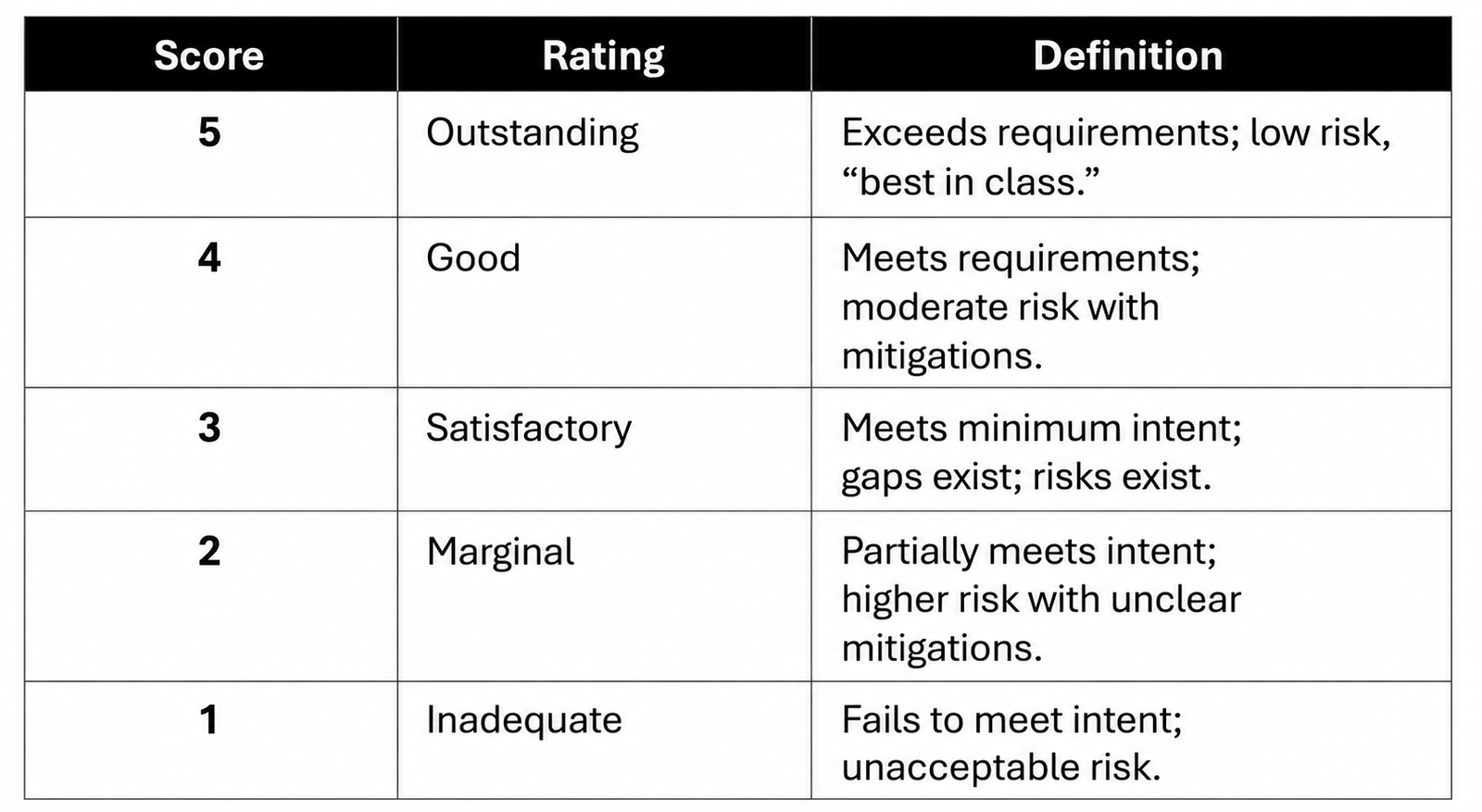
Submissions are scored against the following evaluation factors on the 1-5 scale below. Each factor score is multiplied by its weight, and the weighted results are summed to produce an overall weighted score (5.0 maximum). Weights differ for the Capstone (Challenge IV), where Value to Transition is emphasized.
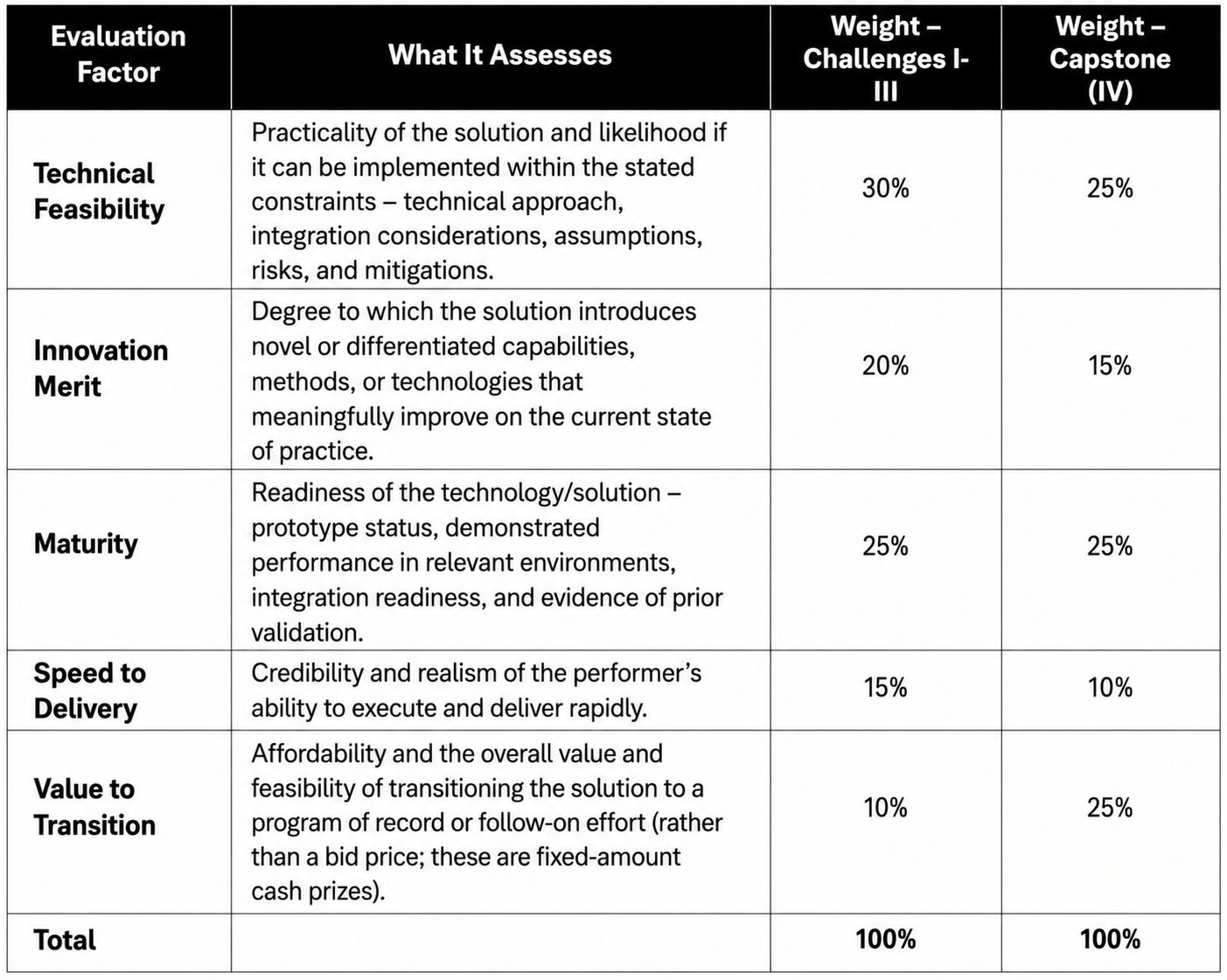
Weights shown are a recommended starting point and may be adjusted in the Official Rules. Weights are applied per challenge: the “Challenges I-III” column governs the individual capability challenges, and the “Capstone (IV)” column governs the full-integration challenge.
Scoring Scale
The following scoring scheme is applied to each evaluation factor:
How Scoring Works
Overall weighted score = Σ (factor score × factor weight), on a 5.0 scale.
Worked example (Capstone weights): Technical Feasibility 4 (×0.25 = 1.00) + Innovation Merit 3 (×0.15 = 0.45) + Maturity 4 (×0.25 = 1.00) + Speed to Delivery 3 (×0.10 = 0.30) + Value to Transition 5 (×0.25 = 1.25) = 4.00 / 5.0.
Submissions are first screened on a pass/fail (go/no-go) basis for completeness and compliance, then scored against the factors above using the 1-5 scale, with scores reached by panel consensus. Evaluators are bound by conflict-of-interest and non-disclosure requirements and recuse from any submission presenting a conflict. Ties are broken by the higher score on the Technical Feasibility factor, then by panel vote. The Government’s selection decisions are final and are not subject to protest or appeal.
Technical Requirements (by Challenge)
Challenge I: Foundation - Digital Platform, Connectivity, and Interoperability (Prize: $50,000)
- Create a digital/web platform or marketplace that can host, ingest, store, organize, and provide user access to simulation model data, digital engineering services, DevSecOps toolsets, and CAD artifacts, with basic discoverability through catalog/search functions.
- Demonstrate standards-based connectivity between the platform and at least one external digital environment using established/open APIs, including reliable ingestion of CAD files, parametric simulation data, and SysML v2.
- Demonstrate artifact management and data exchange sufficient to support reuse and broker services across organizations and DE environments, proving the platform can move and manage core digital-thread artifacts in a practical and interoperable manner.
- Demonstrate the onboarding of commercial assets and purchase methods through the platform.
- Outcome: A functioning web-based digital platform/marketplace is demonstrated that can host and manage core DE and simulation artifacts while providing standards-based connectivity to at least one external digital environment. The demonstration shows discoverability, artifact management, and reliable exchange of CAD files, parametric simulation data, and SysML v2, validating the platform’s ability to support reuse, interoperability, and movement of core digital-thread artifacts across organizations and environments.
Challenge II: Intelligent Simulation Pipeline (Prize: $100,000)
- Demonstrate an intelligent simulation pipeline leveraging commercial technology, modern open standards, and AI-enabled workflow functions to convert DE data into military simulation models for use in (e.g. AtomEngine, OneSAF, VBS, etc.), game engines (e.g. Unreal, Unity, Godot, etc.), or an environment of your choosing.
- Demonstrate the use of AI, including generative AI, to assist in developing simulation behaviors, attributes, or executable content from authoritative DE artifacts and related source data at speed.
- Demonstrate automated or semi-automated transformation steps, such as ingestion, translation, behavior generation, packaging, and deployment, that reduce manual integration effort and improve speed, consistency, and reuse across target environments.
- Demonstrate how CAD, SysMLv2, physical models, and parametric data can be tied together throughout the pipeline to support multiple fidelities of simulation from one Authoritative Source of Truth (ASOT).
- Outcome: An end-to-end “Digital Engineering to simulation” pipeline is demonstrated that uses commercial technology, modern open standards, and AI-enabled workflow functions to convert DE artifacts into an executable experience in at least one target engine. The demonstration shows AI, including generative AI, being used to support the development of simulation behaviors and related executable content, together with automated or semi-automated transformation steps that reduce manual integration effort and accelerate delivery of reusable simulation outputs.
Challenge III: A Practical Application (Prize: $100,000)
- Demonstrate Unmanned Aerial Systems (UAS) as a platform for virtual and constructive training use cases, using commercial UAS parametric and physical data to represent platform shape, dimensions, articulation, movement, performance, effects, survivability, and vulnerability.
- Demonstrate mission-relevant scenarios in which UAS are employed as a weapon to deliver munitions on a hostile target, to intercept enemy UAS, and as hostile drone threats that U.S. Soldiers must detect, react to, and train against in synthetic and/or live environment.
- Leverage existing models from the Army Verse Marketplace (if a Government-furnished marketplace is not available during the prize period, competitors may instantiate and demonstrate their own marketplace capability) and develop reusable UAS data, visual renderings, behaviors, model compositions, and scenarios that can be employed across multiple virtual and constructive training exercises. Demonstrate that UAS assets and scenarios can be cataloged, shared, and reused through the Army Verse Marketplace to support scalable and operationally relevant training applications. Demonstrate the use of the workflow to support at least one other M&S Community use ca/li>
Outcome: A mission-oriented UAS workflow is demonstrated that uses commercial UAS data together with Army Verse Marketplace assets to create reusable platform representations for virtual and constructive training. The demonstration shows UAS employed as a weapon, as a counter-UAS interceptor, and as a hostile threat for Soldier training, while also showing that UAS data, models, behaviors, compositions, visual renderings, and scenarios can be cataloged, shared, and reused through the Army Verse Marketplace. The workflow shows how models supporting the operational context are being used from the Army Verse. The reuse potential of the Army Verse is shown by another M&S Community use being demonstrated.
Challenge IV: Capstone - Full Integration and Scalability (Prize: $200,000)
- Demonstrate the full digital thread from Challenge I through Challenge III using Army representative data, including a functioning digital/web platform or marketplace that hosts, manages, and provides discoverability of simulation model data, DE services, DevSecOps toolsets, CAD artifacts, and other core digital-thread assets, while also demonstrating standards-based connectivity to at least one external digital environment using established/open APIs.
- Demonstrate an end-to-end intelligent simulation pipeline that converts DE artifacts, including CAD files, parametric simulation data, and SysMLv2, into executable content in one or more target environments, including the use of AI-enabled workflow functions and automated or semi-automated transformation steps to develop simulation-ready geometry, attributes, behaviors, packaging, and deployment. Demonstrate the use of the workflow to support at least one other M&S Community use case.
- Demonstrate how CAD, SysMLv2, physical models, and parametric data can be tied together throughout the pipeline to support multiple fidelities of simulation from one Authoritative Source of Truth (ASOT).
- Demonstrate a mission-oriented UAS workflow in which reusable UAS data, visual renderings, behaviors, model compositions, and scenarios are developed and employed for virtual and constructive training use cases, including scenarios where UAS are used as a weapon to deliver munitions on a hostile target, to intercept enemy UAS, and as hostile drone threats that U.S. Soldiers must detect, react to, and train against.
- Scale the integrated ecosystem to 10 users with an update rate of 0.5 Hz (a minimum sustained update rate for simulation entity state, treated as a floor and measured live at Demo Day), and demonstrate that platform-hosted assets, simulation outputs, and UAS-related models and scenarios can be cataloged, shared, reused, and managed through the Army Verse Marketplace.
- Outcome: A full “Challenge I-III” digital thread is demonstrated using Army representative data, showing platform hosting and discoverability, interoperability with external digital environments, intelligent pipeline conversion of DE artifacts into executable simulation content, and a mission-relevant UAS workflow operating as a single integrated ecosystem. The demonstration shows reusable UAS platform representations and scenarios for virtual and constructive training, including UAS employed as a weapon, as a counter-UAS interceptor, and as a hostile threat for Soldier training. The system scales to 10 concurrent users with an update rate of 0.5 Hz, validating multi-user performance, enterprise-level viability, and the Army Verse ability to share, reuse, and operationalize digital-thread assets across the full challenge construct. The workflow shows how models supporting the operational context are being used from the Army Verse. The reuse potential of the Army Verse is shown by another M&S Community use being demonstrated.
Rules
Eligibility Requirements
- Participants must have complied with all requirements set forth in the prize challenge.
- All individuals must be U.S. citizens and 18 years or older.
- Entities must be incorporated in, and maintain a primary place of business in, the United States.
- To receive a prize, the recipient must be registered and active in SAM.gov and not suspended, debarred, or otherwise excluded; the Government may screen participants against SAM exclusions and may require SAM registration before any follow-on award.
- Foreign ownership, control, or influence (FOCI) and organizational conflicts of interest (OCI) may limit or preclude participation where required by export-control law or to protect the integrity of the competition; specifics will be addressed in the Official Rules.
- Except for employees appointed under the STEM Student Employment Program or other student employment programs, Federal employees and support service contractors are not eligible to participate.
- Participants may not use Federal funds to support participation.
Terms and Conditions
Upon submission, the Participant represents and warrants that the submission is original, non-infringing, free of malware, and that the Participant has sufficient rights to authorize use by Army CPE ST3 and partners as specified in the Official Rules.
Intellectual Property Rights
Intellectual Property will be discussed and negotiated during the PWS prototype collaboration. By submitting, the Participant grants the U.S. Government a nonexclusive, royalty-free, worldwide license to use, reproduce, and store the submission and accompanying materials for evaluation and internal Government purposes, while the Participant retains ownership and publication rights in its underlying intellectual property. Rights beyond this license, including any rights associated with a follow-on prototype, are negotiated separately and only with a selected Participant under the applicable instrument (FAR contract, OT, or CRADA).
Data Rights and Marking
- All data submitted under the Prize Challenge will be made available to Army CPE ST3 and parties authorized to act on behalf of Army CPE ST3 (its supporting Government and contractor personnel under non-disclosure obligation: “partners” will be defined in the Official Rules). The Government’s license is limited to evaluation and internal Government use, and only materials releasable to the public may be posted publicly.
- Protective markings (e.g., “Do Not Publicly Release - Trade Secret” or “Do Not Publicly Release - Confidential Proprietary Business Information”) are authorized; participants should be aware submissions may be subject to FOIA.
- Export Controls / ITAR: Submissions containing unclassified technical data with military application may be subject to U.S. export control laws (including the Arms Export Control Act/ITAR); such data must not be exported or shared without required authorization/licensing (using the MCTL as guidance), must be properly marked with an export-control warning, and must be disseminated in accordance with DoD Directive 5230.25.
- Controlled Unclassified Information (CUI): CUI must be marked and handled in accordance with 32 CF Part 2002 and applicable DoW policy, and no classified information may be included in any submission. With each submission, the Participant should provide an export-control self-assessment identifying any controlled content and confirming that all publicly posted materials are releasable to the public.
Relationship of the Parties
- Participation does not imply sanction, endorsement, or support by Army CPE ST3 or the Department of War.
- A Participant may not use an Army CPE ST3 or Department of War logo or official seal in their submission.
Participant Liability and Insurance
Participants assume risks associated with participation; no liability insurance is required to participate . For in-person Demo Day attendance and any live or hardware demonstration, the Government may require participants to sign an assumption-of-risk or event waiver, to be specified in the Official Rules.
Background Information
Follow-On Activities This Open Call Announcement may have potential for follow-on efforts via FAR-based contracting instruments, OTAs, CRADAs, and/or prize competition authorities. This announcement is not a solicitation and is not a commitment by the Government to enter into any agreement or to award any follow-on effort or funds: selection as a prize winner does not entitle a Participant to any follow-on award. Any follow-on activity is subject to the availability of funds and a separate agreement, at the Government’s discretion.
Intellectual Property Considerations Participants grant the U.S. Government and partners permanent access to provided prototypes, documents, and materials for storage/copying in perpetuity, while retaining intellectual ownership and publishing rights.
About CPE ST3 Army CPE ST3’s mission is to rapidly develop, deliver and sustain testing, training and information operations capabilities to enhance readiness across the operational spectrum.
Its vision is to be the leader in delivering unmatched testing, training and information operations capabilities to enhance operational readiness in support of our national defense. A key CPE ST3 priority is to transform solutions with new technologies that modernize capabilities.
Additional Links & Resources
Find additional resources, documents, and FAQ to assist with Prize Challenge participation.
Prize Challenge Virtual Information Session:
Tabletop Exchange Slide Deck
FAQ
Have a Prize Challenge Question?
Reach out to our team by completing the form below.

© Copyright Central Florida Tech Grove. All Rights Reserved
OptimizePress Popup Overlay
Prize Challenge Dates & Details
Official Challenge Launch
July 31st, 2026
Official Prize Challenge Kickoff for all participants
Virtual Info Session
September 23rd, 2026
Learn more about the Prize Challenge process and engage in Q&A
Submissions Deadline
October 15th, 2026, 11:59PM EST
Last day to submit your Prize Challenge solution
Total Cash Prizes
$450,000 ( Across 4 Challenges)
- Challenge I (Foundation - Digital Platform, Connectivity, and Interoperability): $50,000
- Challenge II (Intelligent Simulation Pipeline): $100,000
- Challenge III (Practical): $100,000
- Challenge IV (Capstone - Full Integration & Scalability): $200,000