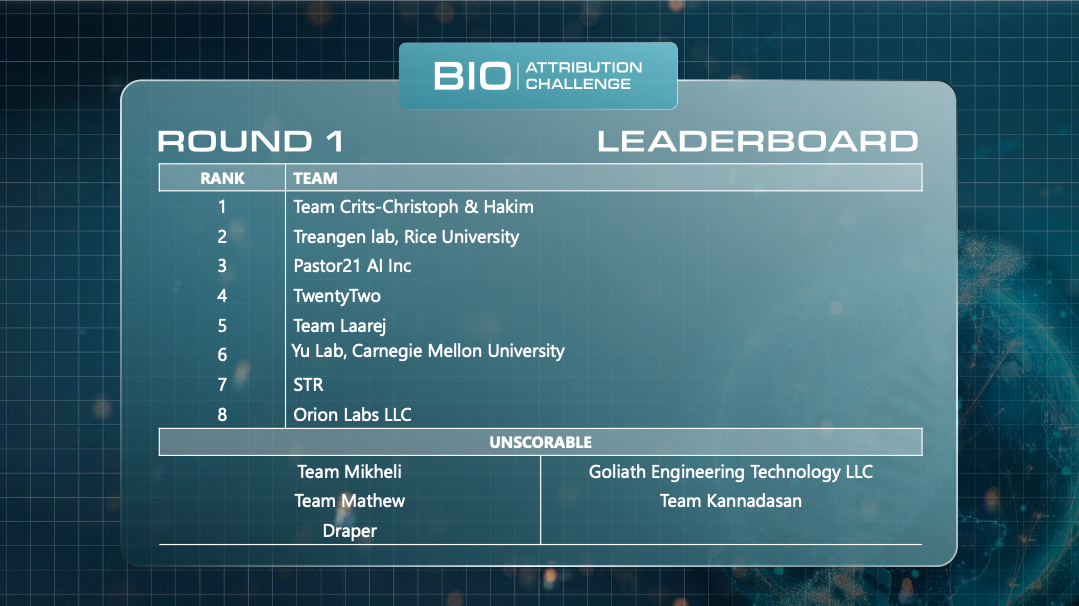
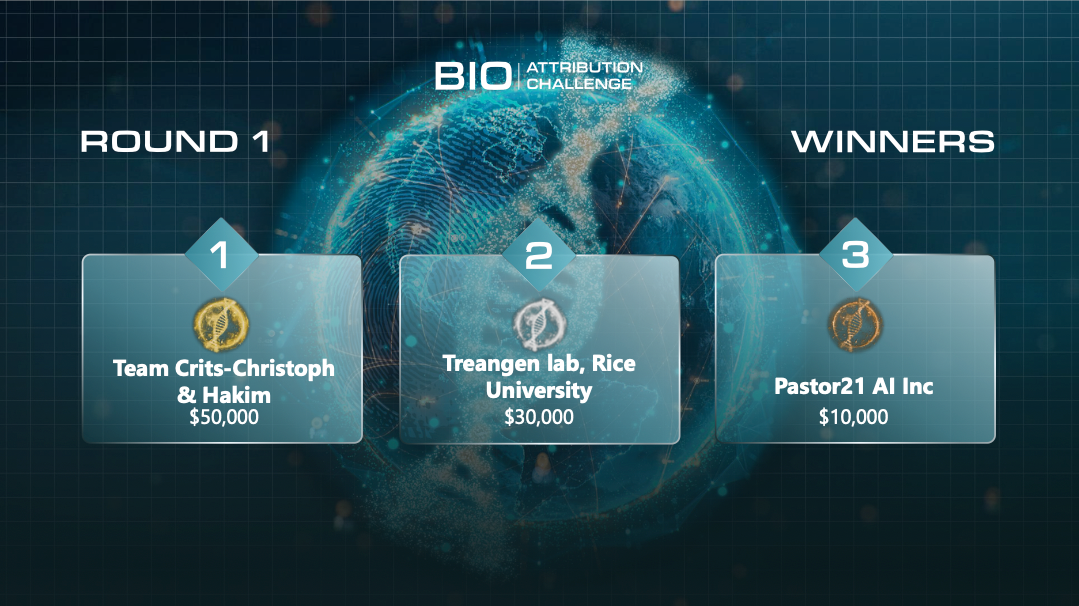
Round 1 Complete. See the Winners

DARPA
Bio Attribution Challenge
The DARPA Bio Attribution Challenge is a virtual competition designed to spur innovation in identifying, characterizing, and attributing modified threat sequence data (protein, gene, and genome) within a simulated environment by probing the frontier of possible methodologies that can provide several orders of magnitude improvements over current state-of-the-art (SOTA) tools.

Prize Challenge Information
Overview
The DARPA Bio Attribution Challenge is a virtual competition designed to spur innovation in identifying, characterizing, and attributing modified threat sequence data (protein, gene, and genome) within a simulated environment by probing the frontier of possible methodologies that can provide several orders of magnitude improvements over current state-of-the-art (SOTA) tools. The competition aims to engage diverse participants from government, academia, and the private sector to advance massive scale data analysis combined with deep homology detection, pushing the boundaries of sensitivity, specificity, speed, and scale.
Participants must demonstrate innovative methods, approaches, and models for achieving precise identification of natural or modified threat agents in near real-time in petabyte scale data sets. Performance will be measured based on accuracy (correct identification and attribution), speed (time to achieve identification and attribution), innovation (novelty of methods), and data efficiency (attribution with minimal data).
The Challenge will be executed in two phases:
Round 1: Detection - Identification & Characterization: Accurately and precisely (i.e. with statistically significant reproducibility) identify and characterize pathogens of concern for human, crop, or livestock health.
Round 2: Determination - Attribution: Accurately and precisely identify unique anomalies, defined as non-routine, high-consequence, or security-relevant sequence- or metadata-derived signatures associated with engineered or otherwise manipulated organisms, intentional pathogen release, or accidental release/containment failure.
Awards:
The structure will include round-specific monetary prizes recognizing the top 3 performers in each round. An overall “Best in Show” and other special (non-monetary) recognitions to acknowledge specific achievements and insights will be provided too.
____________________
A Purely Computational Challenge
This is a purely computational challenge; no actual pathogens or biological materials will be used. All data is deliberately curated and developed by Lawrence Livermore National Laboratory (LLNL) to mimic realistic and complex scenarios without disclosing sensitive information. Participant software will be run in a secure, government-controlled environment.
Timeline
Awards/Prizes
$180,000
Award Distribution
Round-Specific Awards ($180K): Recognizing the top 3 performers in each round for their achievement within that specific stage and the benchmarks established around accuracy, speed, innovation, and data efficiency.
Total Monetary Award Amount: $180K
- Round 1: 1st Prize- $50K, 2nd Prize-$30K, 3rd Prize- $10K (Round 1 Complete- See the Winners)
- Round 2: 1st Prize- $50K, 2nd Prize-$30K, 3rd Prize- $10K
Non-Monetary Awards:
- Best in Show - Awarded to participant demonstrating best overall performance across both rounds, considering accuracy, speed, innovation, and data efficiency.
- Fastest Analysis - fastest methods for analysis off data
- Most Innovative Method - most novel method used for analysis
- Most Data-Efficient - smallest software package to achieve acceptable id, characterization, and attribution
Highest Precision – closest measurements to actual values
Highest Accuracy – most consistency and reproducibility in measurements
Judging/Evaluation Metrics
Round 1: Detection-Identification & Characterization (2 Months)
Round 1 is Complete. See the Winners
Focus: This phase will focus on accurately and precisely (i.e. with statistically significant reproducibility) identify and characterize pathogens of concern for human, crop, or livestock health.
Evaluation Metrics and Considerations
Round 1:
A maximum amount of 8 hrs of compute will be available for each confirmed participant’s software to run.
- Software will process approximately 250 TB of Illumina paired-end FASTQ sequence
- 125TB of synthetic sequence backgrounds will be generated from representative microbiome and metagenomic sequence data. Sequences of concern will be randomly spiked in over a range of abundance levels.
- 125TB real sequence background to be included for comparison, also containing spike-ins (not used for F1 leaderboard scoring)
- Taxonomic calls will be standardized to the NCBI Taxonomy reference version as of September 1, 2025: ftp.ncbi.nlm.nih.gov/pub/taxonomy/taxdump_archive/
- Leaderboard score determined by macro F1 over DARPA-selected organisms of concern, minus the code execution wall-clock time in hours divided by 100 (minimum score 0.1 to be eligible for monetary awards)
Macro F1 is calculated as follows:
For each target organism, calculate F1 score across all samples: F1 = 2 * (Precision * Recall) /(Precision + Recall) where Precision = TP/(TP+FP) and Recall = TP/(TP+FN).
- TP = samples correctly identified as containing the organism.
- FP = samples incorrectly identified as containing the organism.
- FN = samples containing the organism but not identified.
Macro F1 = arithmetic mean of all per-organism F1 scores
Each organism weighted equally regardless of prevalence in dataset
Round 2: Determination-Attribution (1.5 Months)
Focus: This phase focuses on accurately and precisely identifying anomalies, defined as non-routine, high-consequence, or security-relevant sequence- or metadata-derived signatures associated with engineered or otherwise manipulated organisms, intentional pathogen release, or accidental release/containment failure.
Evaluation Metrics and Considerations
Round 2:
- Will include scenario anomaly identification that combines sequence screening with metadata
- Software will process approximately 600 TB – 800 TB of data
- A maximum amount of 24 hrs of compute will be available for each confirmed participant’s software to run.
- Software must accept a path to a metadata input file with columns: sample_id,latitude,longitude,timestamp
- Additional details about metadata will be sent directly to round 2 invitees
- The Scoring criteria will be sent directly to round 2 invitees
How to Enter
Submission guidelines:
- Software should be submitted in a Podman-compatible container format
Maximum size of deliverables is 500 GB
Details on specific endpoint for submission will be provided to confirmed participants
For Round 1, the container may operate without network access (air‑gapped), but internet access is permitted. In Round 2, the container must operate without any network access (air‑gapped only).
- Container must accept input and output directory paths as command-line arguments
- For each sample, software should output one line corresponding to each of the most specific NCBI TaxIDs from all sequences attributable to human, crop, or livestock pathogens that can be identified in the sample using a lowest common ancestor (LCA) strategy
- It is not necessary to include taxonomic parents in the output; all taxonomic parents are included by implication
- Output format: comma-separated values with columns: sample_id, tax_id, confidence_score (optional), concern_flag (optional), read_count (optional), anomaly_index (Round 2 use only)
- Round 1 scoring will be based on the first two fields; other fields are optional in Round 1
A max of 20 participants will be accepted into the challenge for round 1 and a down select will occur to select the participants who will move on to round 2. (Update: 25 participants were invited to round 1.)
At the end of Round 1, invitations will be sent to select participants who will move on to round 2.
Participants who are confirmed to enter the challenge will have a strict compute time limit allocation of 8 hours for their software to run for round 1. If selected to move on to round 2, another 24 hours of compute time will be allocated for software to run for round 2.
Round 1- Detailed Software Guidelines
Round 2- Detailed Software Guidelines will be sent directly to invitees.
Data Safeguards and Participant Information
Data Privacy & Security
- No data will be provided to participants – software will be provided to government for run in government-controlled environment. No actual pathogens or biological materials will be used. This is a purely computational challenge focused on sequence analysis.
- Data handling and access protocols: No sequence data is provided to participants. The government team will handle and run participant software against the challenge data set.
- Data sanitization: Rigorous review of data sanitization procedures to prevent disclosure of any sensitive information or methodologies.
- Non-disclosure agreements (NDAs): Require participants to sign NDAs to protect sensitive information related to the Challenge.
- Publication review: DARPA will review and approve any publications arising from the Challenge to ensure compliance with security and data handling guidelines.
Eligibility Requirements
Registration Eligibility
The DARPA Bio Attribution Challenge is open to individuals and team members of all nationalities and of all ages, with the following exceptions:
- All participants under 18 years of age require parental or guardian authorization.
- An individual, organization, or sponsor is not eligible to apply or participate if they are on the Specially Designated Nationals list.
- U.S. Government organizations and FFRDCs may participate in the DARPA Bio Attribution Challenge but are not eligible for prizes. To the extent there is a limit on the number of participating teams, the participation by Government organizations will not prevent non-federal entities from participating in the Challenge. Government organizations that plan to participate in the Challenge in any manner are encouraged to reach out to DARPA for clarification on these Terms.
- DARPA employees and support contractors, their spouses, dependents, and household members are not eligible to participate.
- Federal employees and contractors acting outside the scope of their employment should consult their ethics official and appropriate management before participating in the DARPA Bio Attribution Challenge.
- To be eligible to win a prize in the Challenge, an each team must have registered to participate in the Challenge in accordance with the instructions outlined herein.
- Individuals may not participate on both DARPA- and self-funded teams for the same competition.
- Individuals from comprehensively sanctioned jurisdictions cannot participate in the challenge.
- All individuals requesting to participate are subject to screening to confirm participation eligibility.
- DARPA reserves the right to disqualify a participant whose actions are deemed to violate the spirit of the competition for any reason, including but not limited to, the violation of relevant laws or regulations in the course of participation in the Challenge.
Award Eligibility
- The DARPA Bio Attribution Challenge prizes are authorized under 10 U.S.C. § 4025, subject to the availability of appropriated funds for which the payment for prize purposes can be made. The Government reserves the right to withhold prizes to ineligible and disqualified participants.
- Tax treatment of prizes will be handled in accordance with U.S. Internal Revenue Service guidelines.
- To receive a monetary prize, participants must provide a U.S. social security or taxpayer identification number (TIN). Information on how to obtain a TIN is available on the U.S. Internal Revenue Website at www.IRS.gov
Challenge Terms and Conditions
DARPA reserves the right to cancel, suspend, and/or modify the Challenge, or any part of it, for any reason, at DARPA’s sole discretion.
Representations:
Upon submission, the Participant hereby represents and warrants that:
- It is the sole author and copyright owner of the submission; that the submission is an original work of the Participant and that the Participant has sufficient rights to use and to authorize others, including DARPA, Tech Grove, NAWCTSD and the Navy, to use the submission, as specified throughout the Official Rules; that the submission does not infringe upon any copyright or upon any other third party rights of which the Participant is aware; and that the submission is free of malware;
- The submission, and any use thereof by the Central Florida Tech Grove, NAWCTSD or the Navy is not defamatory or libelous in any manner; does not constitute or result in any misappropriation or other violation of the publicity rights or right of privacy of any person or entity, or infringe, misappropriate or otherwise violate any intellectual property rights, privacy rights or any other rights of any person or entity;
- It is free to enter into this challenge without the consent of any third party.
The Participant will not attempt to undermine the legitimate operation of the Challenge and understands that doing so may result in disqualification and forfeiture of any prizes. Prohibited conduct includes, but is not limited to: providing false information during registration or regarding eligibility; failing to comply with the Challenge Terms, Guidelines, or Rules; tampering with or interfering with the administration of the Challenge or the participation of other competitors; submitting content that violates third party rights, applicable law, or is lewd, obscene, discriminatory, or otherwise inappropriate; violating the U.S. Department of Defense Social Media User Agreement (https://www.dodig.mil/Disclaimers/Social-Media-User-Agreement/) when using Challenge related discussion forums; threatening, harassing, or engaging in abusive conduct toward other participants or representatives of DARPA, Tech Grove, NAWCTSD, or the U.S. Government. The Government reserves the right to disqualify any individual or organization whose conduct or affiliations bring discredit to the Government or could reasonably be expected to do so.
- There is no suit, proceeding, or any other claim pending or threatened against the Participant, nor does any circumstance exist, to its knowledge, which may be the basis of any such suit, proceeding, or other claim, that could limit or impair the Participant’s performance of its obligations pursuant the Terms and Conditions.
- It will not infringe, violate, or interfere with the intellectual property, publicity, privacy, contract or other right of any third party in the course of performance of this agreement or cause NAWCTSD or the Navy to do any of the same.
- It will comply with all applicable laws, rules, and regulations in performing under these Terms and Conditions; and It otherwise meets the eligibility requirements set forth by the prize challenge.
Data Rights and Marking
- All data submitted under the Prize Challenge will be made available to the Central Florida Tech Grove, NAWCTSD and parties authorized to act on behalf of NAWCTSD. By accepting these Terms and Conditions, the Participant consents to the use of all data submitted by a participant to NAWCTSD.
- The use of protective markings such as “Do Not Publicly Release – Trade Secret” or “Do Not Publicly Release – Confidential Proprietary Business Information,” or similar restrictive markings are authorized. Submission is strongly encouraged where appropriate. However, Participants should be aware that the use of protective markings is not dispositive as to whether information will be released publicly pursuant to a request for records under the Freedom of Information Act, (FOIA) 5 U.S.C. §552, et. seq., as amended by the OPEN Government Act of 2007, Pub. L. No. 110-175. Any information received from the Participant is considered to be a federal agency record, and as such, subject to public release under FOIA. Decisions to disclose or withhold information received from a Participant are based on the applicability of one or more of the nine FOIA exemptions, not on the existence or nonexistence of protective markings. The agency’s designated FOIA Officer will determine if information sought under a FOIA request will be withheld pursuant to one or more of the nine FOIA exemptions. All FOIA requests received are processed in accordance with 32 C.F.R. Part 286. Participants will be notified of any FOIA requests for their submissions in accordance with 32 C.F.R. § 286.10. Following notification by a FOIA processor, participants will be provided the opportunity to review their materials that were requested under FOIA and provide the FOIA processor with comments regarding whether the Participant believes any or all the materials are exempt from release.
Relationship of the Parties
- Nothing contained in these Terms and Conditions is intended to create or constitute a relationship between DARPA, Tech Grove, or NAWCTSD and a Participant. Participation in the Prize Challenge does not imply any form of sanction, endorsement or support of the Participant by DARPA, Tech Grove, or NAWCTSD, nor does it grant either party any authority to act as agent, nor assume or create any obligation, on behalf of the other party. A Participant may not use a DARPA, Tech Grove, or NAWCTSD or Department of Defense logo or official seal in their submission.
Participant Liability and Insurance
- All Participants agree to assume and, thereby, have assumed any and all risks of injury or loss in connection with or in way arising from participation in this challenge, or development of any submission. Upon registration, except in the case of willful misconduct, all Participants agree to and, thereby waive and release any and all claims or causes of action against the Federal Government and its officers, employees and agents for any and all injury or damage of any nature whatsoever (whether existing or thereafter arising, whether direct, indirect, or consequential and whether foreseeable or not), arising from their participation in the challenge, whether the claim or cause of action arises under contract or tort.
- Based on the subject matter of the prize challenge, the type of work that it will require, as well as the unlikeliness of claims for death, bodily injury, property damage, or loss potentially arising from or related to participation in the prize challenge, no individual or entity participating in the prize challenge is required to obtain liability insurance or demonstrate financial responsibility in order to participate in this prize challenge.
Disputes
- Participation constitutes each Participant's full and unconditional agreement to these Official Rules and Terms and Conditions, which are final and binding in all matters related to the challenge. The final scores and determinations are final and binding on all Participants. The final scores of the Judging Panel and the final determination of all Winners may not be challenged by the Participants.
Governing Law
- This Prize Challenge is conducted pursuant to 10 U.S.C. § 4025. These Terms and Conditions are governed by and construed in accordance with Federal law. Any claims arising under or related to this Challenge shall be resolved in accordance with applicable Federal statutes and regulations. To the extent permitted by law, jurisdiction and venue for any claim not otherwise resolved shall lie exclusively in the United States federal courts.
Additional Links & Resources
FASTQ:
- https://learn.gencore.bio.nyu.edu/ngs-file-formats/fastq-format/
- https://knowledge.illumina.com/software/general/software-general-reference_material-list/000002211
Metagenomics:
- https://learn.gencore.bio.nyu.edu/metgenomics/
- https://bioinformaticsworkbook.org/dataAnalysis/Metagenomics/MetagenomicsP1.html
- https://naobservatory.org/blog/biothreat_radar/
Coding Guidelines
Note: Submission files may be encrypted for added security before upload to official submission endpoint. If submitting an encrypted file, please email the passphrase separately to TechGrove@ucf.edu.
Have a Prize Challenge Question?
Reach out to our team by completing the form below.

© Copyright Central Florida Tech Grove. All Rights Reserved
OptimizePress Popup Overlay
Prize Challenge Dates & Details
Official Challenge Launch
March 12th, 2026
Official Prize Challenge Kickoff for all participants
Total Cash Prizes
$180,000
Round 1: 1st Place: $50K, 2nd Place: $30K, 3rd Place: $10K
Round 2: 1st Place: $50K, 2nd Place: $30K, 3rd Place: $10K
Non-Monetary Awards/Acknowledgements:
- Best in Show - Awarded to participant demonstrating best overall performance across both rounds, considering accuracy, speed, innovation, and data efficiency.
- Fastest Analysis - fastest methods for analysis off data
- Most Innovative Method - most novel method used for analysis
- Most Data-Efficient - smallest software package to achieve acceptable id, characterization, and attribution
- Highest Precision – closest measurements to actual values
- Highest Accuracy – most consistency and reproducibility in measurements