
Defense Advanced Research Projects Agency (DARPA)
DARPA Surgical Competition (DSC)
The Defense Advanced Research Projects Agency (DARPA) is running a prize competition to identify a state of the art for trauma surgical robotics. This system must be capable of safely completing specified procedures, collaboratively assisting with open trauma surgery, and rapidly learning new skills.
Prize Competition Information
Overview
The DARPA Surgical Competition (DSC) identifies technologies that can perform autonomous trauma surgery. The vision of DSC is to maximize battlefield survival despite overwhelming casualty volumes by increasing surgical capacity at manufacturing scale. The primary objective is to determine if State-of-the-Art (SOTA) technologies can deliver autonomous trauma surgery or better define the essential technical challenges for doing so. Ultimately, the system must safely, and effectively complete surgeries independently and collaboratively assist human surgeons with complex cases while rapidly learning new capabilities and gaining human trust to complete surgical procedures.
Competing teams will be provided Government Furnished Information (GFI) in the form of strictly de-indexed, low risk (such as cadaveric or animal) datasets of relevant trauma surgery procedures to train autonomous robotic capabilities to provide surgical care. This eliminates privacy friction and maximizes innovation and speed, while maintaining ethical stewardship and strict terms against downstream data reconstruction. The trials will initially assess the key components required for robotic surgical assistance, focusing on a platform’s ability to communicate surgical knowledge, rapidly learn new skills, and safely interact with medical instruments and soft tissue. Upon successfully passing these component gates, platforms will be evaluated on both their collaborative and independent surgical capabilities—two operational configurations that any human surgeon masters before being trusted and credentialed to perform surgeries without supervision on humans.
Evaluation will be conducted by technical personnel experienced in performing trauma surgery, operating surgical robotic platforms, and developing novel autonomous solutions. Ten competitors will be selected based on qualified submissions to participate in the DSC and compete for prizes.
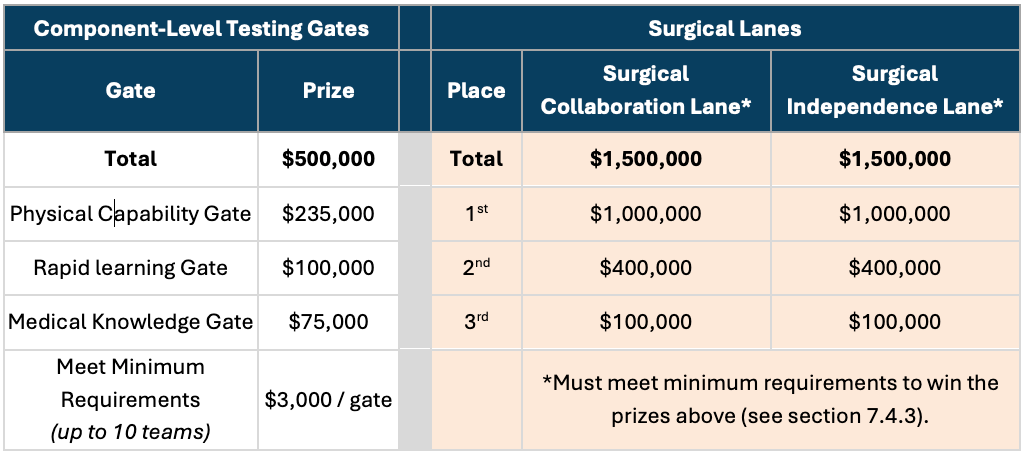
A total prize pool of $3.5M is available for awards to top-performing competitors.
Benefits of Participating
$3,500,000
in total cash prizes
- $500,000 will be awarded to top performers in the component testing gates: $300,000 for first place, $75,000 for second place, and $35,000 for third place. Additionally, teams that achieve minimum gate requirements may earn an additional $3,000 per gate. There will be two comprehensive platform tests: a Surgical Collaboration Lane and Surgical Independence Lane. Teams will compete in both. Winners of each lane will receive prizes:$1,000,000 for first place, $400,000 for second place, and $100,000 for third place.
- Exposure to leaders in surgical robotics and autonomy development, experts in medical device regulation and branches of the U.S. Department of War (DoW) responsible for the development and deployment of autonomous robotic solutions for the military.
- Opportunities to learn from and collaborate with industry, government, and academic leaders and partners in the surgical robotics and autonomous systems space.
- Potential for follow-on opportunities such as Other Transaction Agreements (OTAs), Cooperative Research and Development Agreements (CRADAs), and others.
Eligibility
Registration Eligibility
The DARPA Surgical Competition (DSC) is open to individuals and team members of all nationalities and of all ages with the following exceptions:
- All participants under 18 years of age require parental or guardian authorization.
- An individual, organization, or sponsor is not eligible to apply or participate if they are on the Specially Designated Nationals list.
- U.S. Government organizations and FFRDCs may participate in the DSC but are not eligible for prizes. To the extent there is a limit on the number of participating teams, the participation by Government organizations will not prevent non-federal entities from participating in the Challenge. Government organizations that plan to participate in the DSC in any manner are encouraged to reach out to DARPA for clarification on these Terms.
- DARPA employees and support contractors, their spouses, dependents, and household members are not eligible to participate.
- Federal employees and contractors acting outside the scope of their employment should consult their ethics official and appropriate management before participating in the DSC. DARPA reserves the right to disqualify a participant whose actions are deemed to violate the spirit of the competition for any reason, including but not limited to, the violation of relevant laws or regulations in the course of participation in the Challenge.
- To be eligible to win a prize in the Challenge, each team must have registered to participate in the Challenge in accordance with the instructions outlined herein.
Award Eligibility
- The DSC prizes are authorized under 10 U.S.C. § 4025, subject to the availability of appropriated funds for which the payment for prize purposes can be made. The Government reserves the right to withhold prizes to ineligible and disqualified participants.
- Tax treatment of prizes will be handled in accordance with U.S. Internal Revenue Service guidelines.
- To receive a monetary prize, participants must provide a U.S. social security or taxpayer identification number (TIN). Information on how to obtain a TIN is available on the U.S. Internal Revenue Service website at www.IRS.gov. Foreign nationals will be subject to the U.S. and local tax codes applied to prize awards.
Disqualifications
You may be disqualified from the Competition and forfeit any prizes you may be eligible to receive if DARPA reasonably believes that you have attempted to undermine the legitimate operation of the Competition, including:
- Providing false information about yourself during registration or concerning your eligibility;
- Breaching or refusing to comply with these Terms;
- Tampering or interfering with the administration of the Challenge or with the ability of other participants to participate in the Challenge;
- Determinations that you have failed to comply with the Challenge Guidelines and/or Rules;
- Submitting content that:
a. Violates the rights of a third party
b. Is lewd, obscene, pornographic, racist, sexist, or otherwise inappropriate to the Challenge; or
c. Violates any applicable law
d. Violates the U.S. Department of War Social Media User Agreement at https://www.dodig.mil/Disclaimers/Social-Media-User-Agreement/ (the "Agreement"). Using discussion forums connected with the Challenge constitutes your agreement to comply with the Agreement.ing:
- Threatening or harassing other participants or DARPA, including their employees and representatives. Harassing behavior includes: offensive, threatening, and/or hateful comments directed toward an individual or protected class (gender, sexual orientation, disability, gender identity, age, race, religion, ethnicity, or veteran status), the use or display of sexual images in public spaces, deliberate intimidation, stalking, following, taking unwelcome photos/videos, sustained disruption of talks or other events, inappropriate physical contact, unwelcome sexual attention, and developing and/or promoting any applications designed to encourage any of these behaviors.
- The Government reserves the right to disqualify any individual or organization that brings discredit to the Government or whose actions could reasonably be expected to do so. This includes associations with an organization that might bring discredit to the Government.
* For complete details regarding eligibility, competition rules, and official Terms & Conditions, please visit the official DARPA Competition Website
Problem Statement
Currently, trauma surgical care operates without the integration of robotics or autonomous systems. Effective surgical assistance traditionally requires years of specialized fellowship training; however, during Large Scale Combat Operations and the heightened probability of Mass Casualty Incidents, the Military Health System is understrength and unable to scale to meet the critical demand for care. Consequently, surgical assistance may necessarily come from unskilled and unverified human resources. To address this profound medical capacity shortfall, the DARPA Surgical Competition (DSC) seeks to identify emerging technologies and develop advanced capabilities for autonomous robotic trauma surgery and surgical assistance. The DSC aims to establish a practically "limitless" capacity by developing manufactured autonomous systems that can be rapidly and seamlessly integrated into human surgical teams.
Timeline
- September 14, 2026: Public announcement of the DSC and official release of the Competition Rules. The team qualification and application portal shall open on the Tech Grove Competition Qualification website.
- September 14, 2026 – October 30, 2026: Competition Qualification window. DARPA shall review application submissions on a rolling basis.
- September 22, 2026: Full-day DSC Industry Day Event at the SPA Arlington Research Collaboration Center (SPARCC) in Arlington, VA.
- October 30, 2026: Competition Qualification window closes at 16:00 EST.
- January 15 – 24, 2027: In-person Competition Workshop.
- March 20 – 26, 2027: In-person scored Competition.
- March 26, 2027: Awards Ceremony and joint Technical Hotwash.
Initial Submission Requirements
To qualify teams must complete a set of qualification tasks and submit a narrative description of their approach. Submissions will be reviewed for validity. Qualifying competitors will be notified within 10 business days after the qualification deadline.
It is anticipated that up to 10 teams may successfully qualify for the Competition. Qualifications for the Challenge will be on a “rolling” basis where materials submitted during the open qualification window will be assessed as they are received and DARPA will select up to 10 teams that qualify. DARPA will review all the materials submitted by the Qualification deadline before finalizing the number of qualified teams for the event.
Required submission packet must include:
- Narrative description of proposed system in PDF format
- Link to video of proposed system’s capabilities
Narrative Description
DARPA will use the narrative description to evaluate the team’s overall approach and potentially inform additional follow-up questions and/or tasks. Please submit a PDF format document. The narrative description must include the following sections:
Part 1: Team Information
- Team Name
- Team Organization(s)
- Team Point-of-Contact (name, email, phone number, address)
- Team Roster, i.e., list of all team members, their affiliations and email. If foreign nationals are members of the team, please specify.
Part 2: Technical Approach (500 words max per subsection, images encouraged)
For each element of the Technical Approach below, DARPA will assess whether the plan is consistent with the rules and can safely and successfully compete in the DARPA Surgical Competition.
Experience:
- Note any relevant experience in surgical robotics, teleoperative robotics, and/or autonomous robotic platforms.
Robotic System
- Description of the proposed robotic system
- If multiple systems are proposed to be implemented, specify here.
- Description of parts / subcomponents
- Weight and size of platforms
- Power requirements of full system (including end-effectors & peripherals). Specify if proposed solution will run on wall power or battery.
- Estimated force / torque outputs from system.
End-Effector(s)
- Description of the proposed robotic end-effector(s).
- If multiple end-effector designs are proposed to be implemented, specify here.
- Description of parts / subcomponents
- Weight and size of end-effector(s)
- Estimated force / torque outputs from the end-effector(s).
Perception / Sensing
- Description of sensors proposed for the robotic system.
- Description of implementation of the proposed sensors into the design of the robotic system.
Teleoperation
- Description of the teleoperation control framework
- Description of emergency stop (E-Stop) and safety features
- Description of hardware enabling teleoperation
- Description of user interface.
Autonomy
- Description of high-level software architecture for autonomy.
- Description of algorithms enabling autonomy
- Description of features the sensors & algorithms are identifying to enable autonomous capabilities.
Compute
- Description of local compute hardware.
- Description of network architecture.
Positioning & Safety Plan
- Diagram of system placement around the operating table
- Safety plan for collaborative operations with human surgeons
CIDR Block Information
- Organization’s Static IP Address to be allowed whitelist access to data repository (see GFI section)
Competition Qualification Tasks
Demonstration videos
- Links to unlisted YouTube videos
- Short Description of each video (100 words max per video)
The demonstration videos must include at least the qualification tasks listed in Section 4.2.2 but may also include additional videos that the teams feel will support their submission. DARPA may choose to request additional demonstration videos, a follow-up teleconference, or in-person visit to a team’s site. Teams should be prepared for possible visits, if needed. Only materials received by the qualification deadline will be considered.
Any significant changes in technical approach after initial qualification must be disclosed to DARPA and approved in advance of each event. Examples of significant changes could include different robotic hardware, end-effector hardware, and/or system design. DARPA may require additional demonstrations and/or safety inspections before a new system type may be used in a competition event.
All qualification materials must be submitted via the DARPA Surgical Challenge Team Portal. The narrative description should include links to any videos that are intended to be included as part of the submission.
All videos should be posted to YouTube with the privacy setting set to “Unlisted.” Narration of the videos is allowed.
Robotic Tasks
Robotic Motion
Teams must provide video evidence of their proposed robotic system demonstrating safe motion. Teams must also demonstrate evidence of their proposed end-effectors similarly safely operating. Systems and end-effectors may either be teleoperated or moved through autonomous control. End-effectors are not required to be fully integrated with the robotic platforms at the time of qualifications; however, an integration plan must be included in the qualification narrative.
Emergency stop
Teams must demonstrate emergency stop capability for all robotic systems. All systems participating in the Surgical Challenge must utilize an on-board hardware emergency stop or prove they can otherwise stop all robotic motion with a hardware kill switch.
Surgical Capability
Teams must demonstrate the ability for their robotic system to perform three skills off the following list of surgical capabilities:
- Retract tissue
- Suction fluid
- Irrigate with water
- Adjust lighting
- Pass surgical instruments
- Cauterize tissue
- Suture tissue
- Clamp vessels
- Incise skin
- Lift tissue
Simulated tissue for the video demonstrations may be low-fidelity and conducted on plastic, rubber, silicone, or similar simulated stand-in’s for tissue (e.g., plastic tubing to simulate vessels, rubber mats to simulate skin, foam or chicken to simulate soft-tissue). The goal is to demonstrate the robotic motion capabilities necessary for these surgical skills. Demonstrations may be teleoperated or autonomous.
For any special-case considerations, teams may send inquiries to:
SurgicalCompetition@darpa.mil.
Competition Assessments
The DARPA Surgical Competition seeks to identify emerging technologies and accelerate the development of autonomous surgical robots capable of teaming with human surgeons and operating independently under trauma conditions. The ultimate program objective is to field a robotic trauma surgeon that performs surgical procedures at a level equivalent to a human specialist—safely collaborating, rapidly acquiring new clinical skills, and earning the human trust required for autonomous intervention.
To evaluate these emerging technologies, the DSC is structured into a progressive testing framework consisting of two primary phases: Component-Level Testing (Gates 1–3) and Surgical Procedure Testing (Lanes 1–2). Unlike traditional automation benchmarks, the DSC evaluation framework bridges the gap between purely technical metrics and human clinical standards. Every system will be measured against three primary pillars: efficacy, efficiency, & safety. All surgical assessments will be conducted on surgical phantoms & trainers.
Before progressing to integrated procedural testing, candidate platforms must prove their foundational capabilities across three critical areas: cognitive medical knowledge, physical surgical skills, and real-time adaptability.
Component Gate 1: Medical Knowledge
To demonstrate a cognitive understanding of the operating room environment, platforms must undergo a simulated "Oral Boards" examination conducted by a proctor surgeon. The proctor surgeon will present the platform with visual and spatial queries to evaluate its environmental, anatomical awareness, and the robot's ability to plan and anticipate surgical workflows. To pass this gate, system autonomy is required; teleoperation is not allowed. Systems are allowed only a single attempt for these assessments.
1A. Recognition:
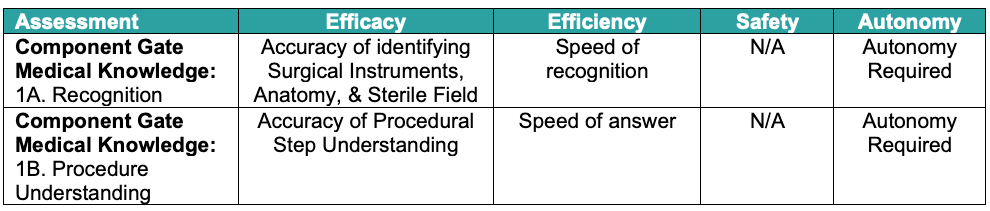
- The goal of this gate is for the robotic system to identify surgical instruments, anatomy, and importantly sterile and non-sterile objects that are around or brought into the surgical field.
- Minimum Requirements: Teams must identify 5 surgical instruments, and 5 specific parts of anatomy through a series of questions with an audible response back to the proctor.
1B. Procedure Step Understanding:
- The goal of this gate is to demonstrate the robotic system’s ability to plan procedures, anticipate surgical workflows, and identify critical safety concerns. For example, given a case/patient problem like a gunshot wound to the abdomen, it can successfully describe the appropriate surgery, anticipate step associated risks, and describe mitigation strategies like a surgeon taking oral boards.
- Minimum Requirements: Teams must demonstrate the ability to correctly anticipate surgical workflows. When given a current state, systems must respond with the next/subsequent steps in a procedural workflow.
Component Gate 2: Physical Capability
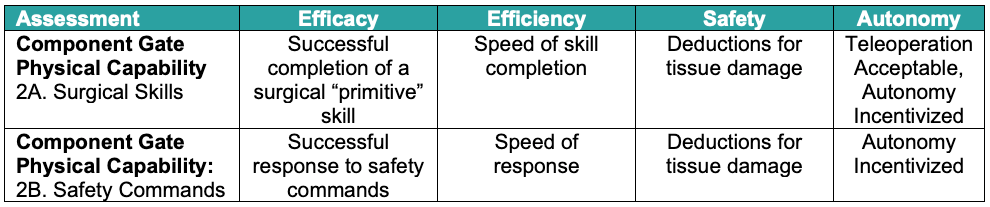
The Physical Capability gate transitions the platform from cognitive processing to physical interaction with surgical simulators and physical assets. Platforms are tasked with executing foundational surgical actions (primitives) across three categories: strength, tension, & dexterity. The gate will also evaluate the system’s ability to promptly adhere to safety protocols and human override commands. This gate may be executed autonomously or with teleoperation; fully autonomous task completion scores more points.
2A. Surgical Skills: Platforms are tasked with executing foundational surgical actions (primitives) across three categories. The goal is to demonstrate the robotic system’s ability to complete the surgical task without surgeon assistance.
- Strength: Abdominal-wall retraction (sustained and stable), internal organ lifting (movement and holding), limb elevation/hold, and laparotomy pack placement.
- Tension: Pulling tissue and suture strands to exact clinical tensions.
- Dexterity: Fluid suctioning, tool grasping and passing, cavity irrigation, vessel clamping, tissue dissection, and throwing sutures.
Minimum Requirements: Teams must demonstrate their system’s ability to complete one surgical skill task in each of the three categories: strength, tension, dexterity. Teams must complete the surgical skills in the allotted time constraint.
2B: Safety Commands: A critical element of clinical trust is a system's adherence to safety protocols and human override commands. The goal is to assess platforms’ abilities to rapidly and safely initiate all responses to an audible safety command without causing injury to the simulated patient or human surgeon. Goal targets would be human-level of timely response.
- Audible Response: System evaluated on ability to safely respond to audible commands to stop all motion, move out of the way without causing harm to the patient, and apply more or less force. Specific commands will be provided at a later date.
- Loss of Signal or Power Response: System evaluated on its safe response to either the loss of communication signal or power to the robot.
- External Interaction: System evaluated on its safe response to external collision from human teammates operating in the surgical field.
Minimum Requirements: Teams must demonstrate their system’s ability to safely and correctly respond to the audible stop command and freeze action in less than 2 seconds. Additionally, teams must safely and correctly respond to commands to move out o the surgical space without damage to tissue.
Component Gate 3: Rapid Learning
Rapid learning is a core component of trauma surgery proficiency. To assess adaptation, the platform will be presented with a completely novel, undisclosed surgical skill. Teams are granted a limited time window to train the robot using any preferred training methodology. To pass and score (goal), the platform must demonstrate mastery by executing the new skill successfully across three consecutive attempts within the time limit.
Note: Successfully passing this gate is not required to participate in Lanes 1 and 2.
Minimum Requirements: Teams must demonstrate mastery of a new observed skill within assessment time limits.

Full Procedure Surgical Lanes:
Platforms that successfully pass threshold requirements in the component gates proceed to integrated, full-scenario testing. These lanes evaluate a platform's capacity to handle dynamic, continuous trauma surgery. To be eligible for prize awards in the Surgical Collaboration (Lane 1) or Surgical Independence (Lane 2) teams must meet minimum requirements defined for each lane.
Lane 1: Surgical Collaboration
In this lane, a human surgeon leads a trauma surgery with the robotic platform participating as an interactive assistant. The procedure contains key points where the lead surgeon issues verbal commands or physical requests to the robot. The system is evaluated on its response to each of these tasks (individual surgical steps/skills). Teleoperation of whole or partial tasks is acceptable; however, scoring incentivizes autonomy.
Minimum Requirements: Teams must successfully complete 50% of the commanded tasks. At least one (1) of the successfully completed tasks must have been autonomous.

Lane 2: Surgical Independence
This assessment lane requires the robot to act as the primary surgeon. A simulated trauma patient is presented in the operating room. The platform must independently evaluate the patient, formulate a diagnostic assessment, establish an operative plan, and execute the complete trauma procedure. The system is evaluated against essential (key) sub-task outcomes (results from portions of a procedure when it is required to understand and execute the correct surgical step) throughout the trauma surgery. Surgical decision making should be autonomous, however a human may confirm or correct the systems decision about the planned procedure or step before the system executes (full credit for autonomous correct and executed decision, partial credit or human confirmation prior to execution, and no credit for human correction of decision). Teleoperation of each physical surgical step/skill is acceptable; however, scoring incentives autonomy.
Minimum Requirements: Teams must successfully complete 50% of the identified necessary surgical tasks for the procedure. At least one (1) of the successfully completed tasks must have been autonomous.

Technical Requirements
This section outlines the core technical specifications and constraints for systems participating in the DARPA Surgical Competition. To ensure fair assessment, safety, and logistical feasibility, all participating teams must adhere strictly to the requirements detailed below.
1. System Design
- There are no restrictions or specific requirements regarding the underlying design, architecture, or mechanical approach of the surgical robotic system, provided it adheres to the size, power, and safety constraints outlined in this section.
- Teams are welcome to utilize existing commercial platforms, adapted off-the-shelf technologies, or completely novel, custom-built approaches. All are equally accepted and encouraged.
- There is no requirement for FDA approved systems, or medical grade subcomponents. Human tissue will not be utilized at any portion of the assessment.
2. Size
- When fully packaged for transport, the system must be capable of fitting through standard doorways and office hallways.
- Teams will be permitted to unpack, assemble, and calibrate their systems in the designated assessment operating room one day prior to the scheduled assessment.
- The fully deployed system must fit comfortably inside a standard operating room without obstructing essential medical personnel or facility infrastructure. The longitudinal footprint of the robotic system(s) must not exceed the length of a standard operating room table (84 inches or 213 cm).
- The system must allow for a human surgeon to freely operate on one side of the operating table.
3. Power
- The system must operate reliably on standard U.S. wall power (120V / 60Hz).
- If a system is designed for a different power standard, the participating team must supply all necessary, safety-certified power adapters and transformers to ensure seamless and safe integration with standard U.S. wall outlets.
4. Networking & Compute
- All computational processing must be performed locally on the machine / in the room. Systems are strictly prohibited from reaching out to exterior, cloud-based compute locations or external internet services.
- During the evaluation, all systems will operate on a secure, closed assessment network provided and managed by the Independent Verification and Validation (IV&V) support team.
- Operating on the local assessment network enables the IV&V team to actively monitor all network traffic. This ensures compliance with challenge rules, confirms network isolation, and verifies that no unauthorized external communication is attempted.
5. Security & Foreign Origin Compliance
- The official assessment will take place on-site at a U.S. Military Installation. Teams must comply with all facility access and operational protocols.
- All systems, including their constituent hardware and network devices, must strictly adhere to U.S. Department of War security restrictions regarding foreign-made advanced robotics and telecommunications equipment. Teams are responsible for auditing their supply chains to ensure compliance prior to arrival.
No systems, subsystems, software, or components developed, manufactured, or serviced by entities on the DoD Section 1260H List of Chinese Military Companies are eligible for integration or participation. Competitors must formally certify compliance with these parameters prior to arrival. Failure to pass this supply chain audit shall result in immediate disqualification and prize forfeiture.
6. Insurance
- Competitor teams must obtain and maintain comprehensive liability insurance covering all operational risks associated with robotic systems, transport, and physical participation in the competition events. Proof of insurance must be submitted prior to the setup phase.
7. Establishment in Operating Room
- Teams must unpack, assemble, and calibrate their systems in their designated assessment operating room exactly one day prior to their scheduled assessment.
- Teams must establish their system around the operating table such that a human surgeon has free access to the patient from at least on side and could operate simultaneously with the system. Neither should be obstructed or restricted by the other. Safe egress from the table must be maintained for the human surgeon. A representative example is shown below (Figure 2).
- Teams must provide a diagram and safety plan detailing base placement and surgeon safe egress process and path and part of qualification. The Chief Judge has sole discretion and reserves the right to deny set-ups that may be unsafe.
- While bases are restricted to one side of the bed to preserve a safe corridor of egress for human surgeons, the robotic arms may reach across the entire operating field as required to complete clinical tasks.
Terms and Conditions
Ownership, Rights in Your Submissions, Sharing
- Ownership: Self-funded teams retain all intellectual ownership and publishing rights.
- DARPA will not disclose the technical briefs or code bases submitted by participants outside the Government except where this information is handled by DARPA support contractors for administrative purposes and/or to assist with technical evaluation. All DARPA support contractors performing this role are bound by nondisclosure agreements.
- Sharing Your Information: Government-funded and self-funded teams may be featured on the DSC website. We will not disclose your contact information if you do not wish to share it with the public. Photos and text descriptions of Challenge events may be posted on the DSC and other DARPA-affiliated social media sites.
Government Furnished Information (GFI)
DAPRA is partnering with the MIT Lincoln Laboratory (MIT-LL) to host Government Furnished Information in the form of surgical datasets to be provided to qualified competitors via the AGENT RAPIDS data repository.
The AGENT RAPIDS site is an Impact Level 4 (IL4) environment hosted on AWS Gov Cloud. Due to the Lab’s security posture and the nature of the data on AGENT, we need a sponsoring agency to identify organizations that need access. We then need organizational-level IP addresses (CIDR blocks) to whitelist traffic from those organizations.
Organizations with static IP addresses can get their information from the following links:
- https://checkip.amazonaws.com/
- https://api.ipify.org/
- Checking both links helps to ensure we capture any IPs/Networks traffic origins
- Individuals will need to visit those URLs from the same network they plan on accessing AGENT RAPIDS from. For instance, they should ensure they are connected through their organization’s VPN before trying to determine their IP address.
We will need to coordinate directly with the organization’s IT personnel if the organization uses dynamically allocated IP addresses.
IT personnel should be able to assist if people have issues with the instructions above.
Please note that it takes our security personal about 2 weeks to approve a whitelist request once it is received.
By registering for this competition and accessing the provided data, Competitors agree to be bound by the following strict terms governing the use, protection, and operational boundaries of GFI.
1. For the strict purposes of this Competition, GFI is defined as curated, non-operational physiological and structural datasets jointly owned by DARPA and the Uniformed Services University (USU), exclusively for research purposes, and derived exclusively from animal or de-identified cadaveric models. The GFI provided has been rigorously scrubbed and structurally de-identified and de-indexed to ensure the absolute absence of any Personally Identifiable Information (PII) or Protected Health Information (PHI). It is provided “as-is” solely as an innovation catalyst for the parameters of this competition.
2. Competitors operate as temporary, secure stewards of the GFI. While the data is inherently low-risk, maintaining its integrity is mandatory. Competitors are expressly bound to:
- Maintain commercially reasonable administrative, physical, and technical safeguards to protect the GFI.
- Prevent unauthorized distribution, public hosting, or open-source release of the raw or derivative GFI datasets
- Ensure that only formally registered team members have access to the downloaded GFI.
3. The authorization to download, process, and analyze GFI is a limited, non-transferable, and revocable privilege. Competitors agree that:
- The GFI may be utilized exclusively for the design, testing, and submission of solutions directly responsive to this competition.
Competitors are strictly prohibited from retaining, commercializing, or repurposing GFI to train external algorithms, develop parallel commercial products, or conduct secondary research outside the explicit scope of this competition.
- Upon the conclusion of the Competition (or upon withdrawal/disqualification), Competitors must immediately cease all use of the GFI and purge data from their local environments.
Competitors are strictly prohibited from retaining, commercializing, or repurposing GFI to train external algorithms, develop parallel commercial products, or conduct secondary research outside the explicit scope of this competition.
4. Competitors must unconditionally respect the de-identified status of the GFI. By accessing it, Competitors commit to the following absolute prohibitions:
- Reconstruction by executing any process, script, or analysis intended to re-identify, reverse-engineer, or trace the data of a specific human or proprietary origin is strictly prohibited.
Commingling for interference by merging, combining, or cross-referencing the GFI with external databases (public or private) in any manner that creates risk of tracing or inferring identity or reconstructing restricted metadata is strictly prohibited.
- Inadvertent discovery of an anomaly that resembles PII or PHI within the GFI data requires an immediate halt to processing, file isolation, and notification to competition administration without attempting to verify the data.
Commingling for interference by merging, combining, or cross-referencing the GFI with external databases (public or private) in any manner that creates risk of tracing or inferring identity or reconstructing restricted metadata is strictly prohibited.
Organizational Conflicts of Interest
DARPA is committed to ensuring fairness to all competitor teams. To avoid organizational conflicts of interest (OCI)1 or the appearance of OCI, all D2C competitor teams with access to relevant data collected for the D2C must submit an OCI mitigation plan2. DARPA will review all OCI mitigation plans. DARPA has sole discretion to determine whether an OCI mitigation plan is sufficient to avoid, neutralize, or mitigate an OCI. DARPA may disqualify competitors with an OCI.
1.OCI definition
An “OCI” means that because of other activities or relationships with other persons, a person is unable or potentially unable to render impartial assistance or advice to the Government, or the person’s objectivity in performing the contract work is or might be otherwise impaired, or a person has an unfair competitive advantage. The three types of OCIs are biased ground rules, unequal access to information, and impaired objectivity.
2. OCI mitigation plan
In the case of an OCI or the appearance of an OCI, an OCI mitigation plan must be submitted to demonstrate
1. measures to firewall individuals in the organization(s) in questions; and
2. measures to firewall DSC data from the individuals who would participate in the DSC competitions. DARPA will evaluate the adequacy of these measures to determine if the proposed measures sufficiently avoid, neutralize, or mitigate the OCI. An OCI mitigation plan that does not avoid, neutralize, or mitigate an OCI may result in disqualification from the competition. DARPA has sole discretion to disqualify any competitors.
Additional Information
Questions regarding rules should be sent to SurgicalCompetition@darpa.mil
DARPA may modify the rules in writing at any time and for any reason, including the accommodation of a promising technical approach that would have been excluded by the rules.
DARPA unilaterally reserves the right to cancel or modify the Competition at its sole discretion. All participants in the competitions of this Competition shall sign, as part of the registration process, the Event Participation Agreements.
Disputes
Participation constitutes each Participant's full and unconditional agreement to these Official Rules and Terms and Conditions, which are final and binding in all matters related to the Competition. The final scores and determinations are final and binding on all Participants. The final scores of the Judging Panel and the final determination of all Winners may not be challenged by the Participants.
* For complete details regarding eligibility, competition rules, and official Terms & Conditions, please visit the official DARPA Competition Website
Background Information
About the Defense Advanced Research Projects Agency (DARPA)
The Defense Advanced Research Projects Agency (DARPA) is an independent research and development agency within the U.S. Department of War (DoW). Created in response to the launch of Sputnik in 1957, DARPA stands as the nation’s commitment to never again face a strategic technical surprise. Working with innovators inside and outside government, the agency has delivered on its mission many times over – transforming the seemingly impossible into world-changing defense and national security capabilities. Often, DARPA innovations also become fixtures of modern civilian life. Unlike other agencies, DARPA is not satisfied with incremental advances. It pushes transformational breakthroughs – innovations that not only solve current challenges but also establish the U.S. as the leading driver of strategic technological invention.
About Naval Air Warfare Center Training Systems Division (NAWCTSD)
The Naval Air Warfare Center Training Systems Division (NAWCTSD) is the principal Navy center for research, development, test and evaluation, acquisition, and product support of training systems. NAWCTSD provides inter-service coordination, and training systems support for the Army, Marine Corps, and Air Force. NAWCTSD is a foundational member of Team Orlando, a unique collaborative with training and simulation divisions of the Army, Marine Corps, Air Force, and Space Force, as well as academia and key supporting economic development organizations. www.navair.navy.mil/nawctsd
About the Central Florida Tech Grove
The Central Florida Tech Grove is a Department of Defense innovation hub established in 2020 under a Partnership Intermediary Agreement between the Naval Air Warfare Center Training Systems Division and the University of Central Florida Research Foundation. The Tech Grove was founded as a multi-service innovation hub with funding from the Navy, Army, Air Force, and Marine Corps training commands as well as the Office of Naval Research and the Office of the Secretary of Defense. With a three-pronged mission to (1) grow the defense industry base, (2) facilitate technology transfer and transition, and (3) solve problems, the Tech Grove executes a wide range of initiatives that bring together entrepreneurs, industry, academia, and government from across the United States and internationally to develop innovative solutions for military human performance. www.centralfloridatechgrove.org
Additional Links & Resources
* For complete details regarding eligibility, competition rules, and official Terms & Conditions, please visit the official DARPA Competition Website
Have a Prize Competition Question?
For Rules and Technical Prize Challenge Questions please contact the DARPA Surgical Challenge team at: SurgicalCompetition@darpa.mil
For all other Questions please reach out to the Central Florida Tech Grove Team at TechGrove@UCF.edu

© Copyright Central Florida Tech Grove. All Rights Reserved
OptimizePress Popup Overlay
Prize Competition Dates & Details
Official Competition Launch
September 14th, 2026
Official Prize Competition Kickoff for all participants
DSC Industry Day Event
September 22nd, 2026
Full day event- Arlington, VA
Submissions Deadline
October 30th, 2026
Competition Qualification Window Closes 16:00EST
Competition Workshop Event
January 15-24th, 2027
In-person Competition Workshop
Competition Trials Event
March 20-26th, 2027
In-person scored assessment of the proposed systems
Total Cash Prizes
$3,500,000
Lane 1: 1st Place: $1M, 2nd Place: $400K, 3rd Place: $100K
Lane 2: 1st Place: $1M, 2nd Place: $400K, 3rd Place: $100K