Prize Submission Deadline Extended to 9/27/26

Naval Air Warfare Center Training Systems Division(NAWCTSD)
Performance Support Video Factory Prize Challenge
The Central Florida Tech Grove, in partnership with the Naval Air Warfare Center Training Systems Division (NAWCTSD) and the Career Training Continuum (CTC) program office, PMW-260, is running a prize challenge to identify proof of concept solutions that automate the production and lifecycle sustainment of Performance Support videos for Navy maintenance and operational tasks. This challenge seeks to convert authoritative technical source material into short, standardized, highly compressed training videos, and to keep those videos current as the underlying technical baseline changes, in order to deliver point of need training to Sailors in austere and afloat environments.


Prize Challenge Information
Overview
Fleet maintenance and operational tasks are documented in technical manuals, maintenance procedures, and equipment configuration data that change continuously. Converting that material into usable video training is today a manual, labor-intensive process, and once a video is produced there is no automated means of identifying which segments are invalidated when a technical baseline changes. The result is a training library that is expensive to produce and that degrades in accuracy over time.
This challenge is executed in three phases. Phase 1 is an open call in which Applicants submit evidence of existing capability. Phase 2 requires the Top 10 Semifinalists to produce a script, storyboard, and traceability manifest from a common commercial maintenance source package, so that every Semifinalist is measured against the same task under the same conditions. Phase 3 requires the Top 5 Finalists to produce a Navy-specific prototype video from Government Furnished Information and to demonstrate the complete workflow live at the Demonstration Day event.
Submissions are evaluated by a panel of Government subject matter experts drawn from NAWCTSD, PMW-260, and supported in Phase 3 by Fleet subject matter experts who assess the technical accuracy of scripts, storyboards, and finished video.
Three winners are selected at the Demonstration Day on 5 November 2026.
The total prize purse is $160,000.
Note: All proposed solutions shall be commercially available / non-developmental technologies. Submissions describing technologies still under development, in prototype form, or requiring additional engineering to achieve production readiness are outside the scope of the prize challenge and will not be considered.
Timeline
- 20 August 2026: Release of the complete prize challenge package.
- 25 August 2026: Prize Challenge release and application portal open. Announcement distributed via the Central Florida Tech Grove website, email campaigns, and other information distribution channels.
- 27 September 2026: Deadline for Phase 1 submissions, 11:59 p.m. Eastern Time, submitted through the designated portal. Submissions must meet the Phase 1 Submission Requirements.
- 2 October 2026: Evaluation of Phase 1 submissions complete. Up to 10 Semifinalists selected to participate in Phase 2.
- 5 October 2026: Phase 2 begins. The Central Florida Tech Grove issues the Phase 2 instructions and the common commercial maintenance source package to the Semifinalists.
- 8 October 2026: Deadline for Phase 2 submissions, 11:59 p.m. Eastern Time.
- 13 October 2026: Evaluation of Phase 2 submissions complete.
- 14 October 2026: Phase 3 begins. Up to 5 Finalists selected and notified. Each Finalist is assigned a specific Performance Support video and receives the applicable Government Furnished Information, scoping information, and Phase 3 instructions.
- TBD 2026: Site visit data collection. Each Finalist is supported by an assigned Government guide or subject matter expert.
- 2 November 2026: Deadline for Phase 3 submissions, 11:59 p.m. Eastern Time. Fleet subject matter expert review of the submitted prototype videos, with technical discrepancies documented, adjudicated, and resolved.
- 5 November 2026: Demonstration Day and selection of the three winners. Winners are announced at the end of the event and receive the $55,000, $30,000, and $20,000 awards.
- 12 November 2026: Written notification of final placements to all Finalists.
- 12 December 2026: Completion of stipend and prize payment.
All dates and times are Eastern Time. Where a deadline falls on a weekend or Federal holiday, the deadline is not extended.
Prizes
$160,000
in total cash prizes
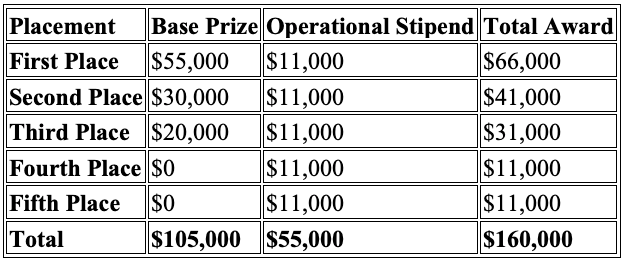
The total prize purse is $160,000, consisting of $105,000 in base prize awards and $55,000 in operational stipends. Each of the five Finalists receives an $11,000 operational stipend, consisting of $7,000 for prototype production and $4,000 for travel and data collection. Final awards combine the stipend with the base prize.
- The operational stipend is paid to each Finalist upon execution of the Finalist agreement and before performance, to the single legal entity designated by the Finalist.
- Fourth-place and fifth-place Finalists are awardees. They remain subject to the same deliverable, intellectual property, publicity, and tax obligations as prize-winning Finalists, and their prototypes and sustainment packages remain required and deliverable to the Government.
- Base prizes are paid within thirty days of written notification of final placements.
- A Finalist that withdraws, that fails to deliver the required prototype and sustainment package, or that fails to appear at the Demonstration Day forfeits any unpaid amount.
- Each awardee is solely responsible for all Federal, state, and local tax obligations arising from any stipend or prize and will receive tax reporting as required by law.
- The Government is not obligated to make every award. If fewer than ten responsive Phase 1 submissions are received, or fewer than five Semifinalists are assessed as qualified, the Government may reduce the number of Semifinalists or Finalists, may decline to make a base prize award in any tier, or may cancel the challenge. Awards will not be split between Participants.
Additional Considerations:
- Direct access to authoritative Navy technical source material as Government Furnished Information in Phase 3, including a funded site visit for on-site data collection.
- Exposure to leaders across Team Orlando and other components of the Department of War responsible for the development and deployment of training solutions.
- Opportunities to learn from and collaborate with industry, government, and academic leaders working in automated content generation and training sustainment.
- Potential for follow-on opportunities such as Other Transaction Agreements (OTAs), Cooperative Research and Development Agreements (CRADAs), and FAR-based contract awards.
Problem Statement
Sailors require immediate, point of need access to accurate procedural training for complex maintenance and operational tasks, frequently in austere or afloat environments with degraded or disconnected network access. Producing Performance Support video from authoritative technical source material is currently manual and slow, and the resulting products cannot be traced back to the source material that governs them. When a technical manual, maintenance procedure, or equipment configuration changes, there is no automated means of identifying which video segments are affected, which forces either wholesale reproduction or acceptance of outdated training content.
The Government seeks solutions that automate the conversion of authoritative source material into standardized, compressed, offline-playable Performance Support video; that establish and maintain a source-to-segment traceability record for every asset produced; that automatically flag affected content when a source baseline changes; and that support a subject matter expert review and re-render workflow so that corrections can be validated and republished rapidly.
How to Enter
Participants will deliver the following by 11:59 p.m. Eastern Time on 25 September 2026 through the designated portal.
The two primary artifacts are mandatory. A submission that omits either artifact, or that omits the required certifications, is non-responsive and will not be evaluated.
View Full Prize Challenge Details
Initial Technology and Capability Evidence
Provide:
- A concise description of the algorithmic approach, software architecture, and commercial generative tools employed.
- The proposed deployment model, identifying which functions require cloud services and which operate disconnected.
- One or more representative outputs or demonstrations that substantiate the claimed capability. Representative outputs are limited to three video samples of not more than five minutes each, provided as streaming links that require no account, password, or software installation.
- A statement of the measured wall-clock time to generate a compliant three-minute Performance Support video from source input, together with the hardware and service configuration on which that time was measured. Estimated or projected times must be identified as such.
Recommendation to Produce Videos & Experience
Provide:
- A production and sustainment plan showing how the technology maps to military instructional constraints, adult learning methods, offline delivery, and the required production-artifact package.
- An explicit description of automated baseline Configuration Management, including how the platform maps videos and editable source artifacts to technical-manual versions, procedures, and equipment configurations.
- A description of how a subject matter expert reviews flagged content and how corrected content is re-rendered and republished.
Cyber and Supply Chain Evidence
In addition to the two primary artifacts, provide:
- A software bill of materials for the proposed generation, hosting, and delivery components.
- An inventory of third-party and open-source dependencies, together with the license under which each is provided.
- A statement of the Participant's most recent vulnerability scanning results and remediation status.
Autonomy Disclosure
Each submission must state the extent of human involvement in producing the representative outputs, including any manual scripting, editing, correction, or post-production.
Human review and editing are permitted at every stage of this challenge. Undisclosed human involvement is grounds for disqualification.
Format and Limits
The written package is limited to ten single-sided pages, exclusive of the cover page, the certifications, and the Cyber and Supply Chain Evidence, in Portable Document Format, 11-point minimum font, with one-inch margins.
Representative outputs are limited to three video samples of not more than five minutes each and must be provided as streaming links that require no account, password, or software installation.
Late submissions will not be accepted. A Participant may amend or replace its submission at any time before the deadline, and the last complete submission received controls. The Government will not seek clarification of, or permit correction of, an incomplete submission after the deadline.
View Full Prize Challenge Details
Judging Criteria
Submissions will be evaluated by Subject Matter Experts (SMEs) with expertise in DE, M&S, AI/ML, enterprise platforms, and interoperability.
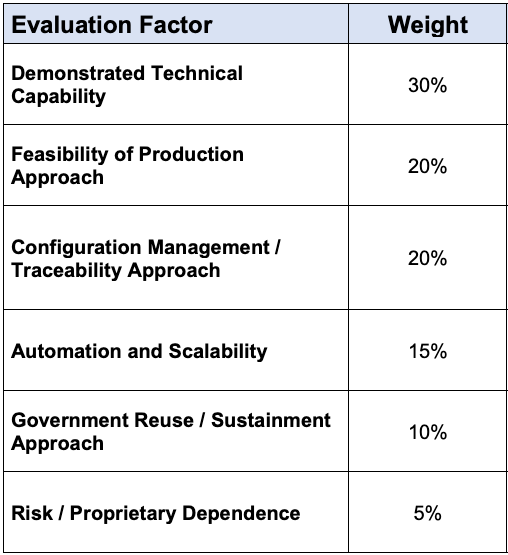
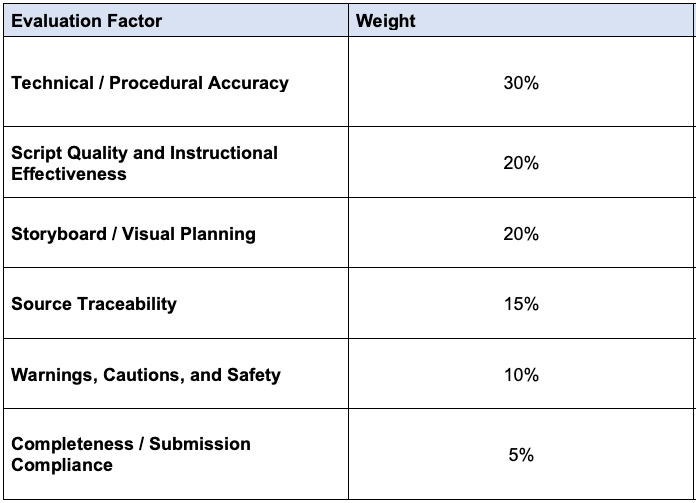
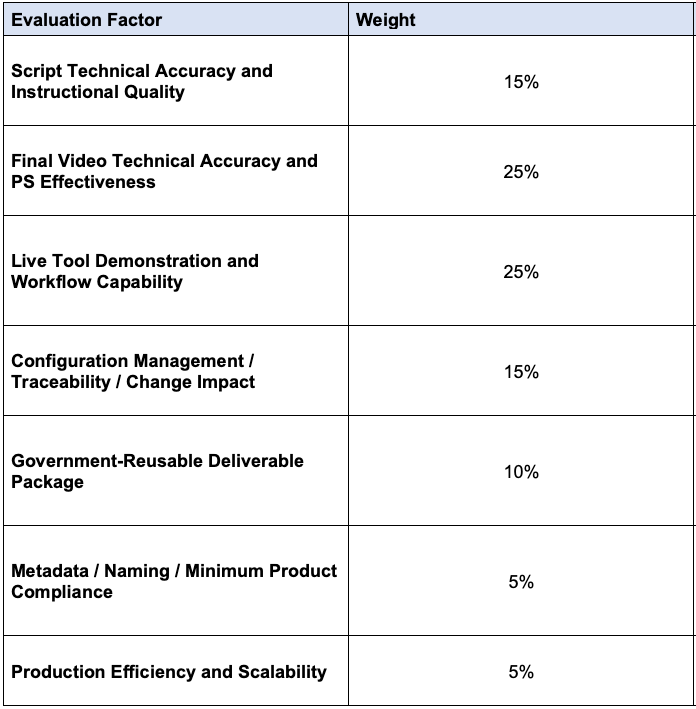
Submissions are scored against the following evaluation factors on the 1-5 scale below. Each factor score is multiplied by its weight, and the weighted results are summed to produce an overall weighted score (5.0 maximum).
Phase 1 Judging Criteria
Phase 1 determines whether the entrant has a credible, demonstrated capability and production approach that warrants advancement to the Top 10. The Government will score only the capability evidence and approach submitted in Phase 1.
Phase 2 Judging Criteria
Phase 2 Submission Requirements:
Semifinalists will deliver the following by 11:59 p.m. Eastern Time on 8 October 2026 through the designated portal.
Phase 2 uses a common commercial maintenance source package issued to every Semifinalist on 5 October 2026. The task is a discrete commercial maintenance action. It requires no Navy-specific Government Furnished Information, and it contains no controlled, proprietary, or export-restricted data. Every Semifinalist receives the same source package, the same evaluation criteria, and the same response period.
- A complete script for the assigned commercial maintenance task, generated by the Participant’s platform from the provided source package.
- A complete storyboard corresponding to the script.
- A source-to-script traceability manifest mapping each script element, warning, visual cue, and performance objective to the specific element of the provided source package that governs it.
- An autonomy disclosure stating the extent of human involvement in producing the Phase 2 submission.
For purposes of this challenge, autonomously means generated by the Participant’s platform from the provided source package without Government assistance. Human review, editing, and correction of platform output are permitted and must be reported in the autonomy disclosure.
Participants should note that the Phase 2 response period is four working days. Participants are advised to have their production workflow configured and tested before Phase 2 instructions are issued.
Phase 2 Judging Criteria:
Phase 2 evaluates only the script, storyboard, and source traceability package produced from the common commercial maintenance source package. Video quality, final metadata, cloud architecture, cyber architecture, and re-rendering are not scored in this phase.
Phase 3 Judging Criteria
Phase 3 Submission Requirements:
Finalists will deliver the following by 11:59 p.m. Eastern Time on 2 November 2026 through the designated portal, and will present at the Demonstration Day on 5 November 2026. Each Finalist is assigned one specific Performance Support video from the Navy candidate pool on 14 October 2026 and receives the applicable Government Furnished Information, scoping data, and site survey material on that date.
- The finished Performance Support video for the assigned task, provided in H.264/AVC in an MP4 container as the mandatory baseline rendition.
- The complete sustainment package described in Technical Requirements below.
- Evidence that the solution can flag an affected segment when a source baseline changes, support subject matter expert correction of that segment, and re-render the revised content.
- An autonomy disclosure stating the extent of human involvement in producing the Phase 3 submission.
Finalists are funded to attend the site visit on 21 to 22 October 2026 and the Demonstration Day on 5 November 2026 through the operational stipend described under Prize Structure and Payment.
Prize Challenge Demonstration Day:
On 5 November 2026, the five Finalists will present at the Central Florida Tech Grove in Orlando, Florida. Rather than requiring Finalists to generate an entire video on the demonstration floor, a suitable portion of the video may be presented in the time allotted. Each Finalist must arrive with the finished prototype developed from the assigned Government Furnished Information and must demonstrate the end-to-end workflow live, including ingestion of a changed source baseline, automated flagging of the affected segment, subject matter expert correction, and re-rendering of the corrected asset.
Members of the public will be invited to register to observe the demonstrations and presentations. Individual sessions with the judges and the judges’ deliberation to determine the winners will be closed to the public. The three winners will be selected and announced at the end of the day.
Phase 3 and Demonstration Day Judging Criteria:
Phase 3 evaluates the Navy-specific script, final Performance Support video, Government-reusable deliverable package, and a live demonstration of the tool/workflow used to create, review, modify, trace, and sustain the product.
Scores do not carry forward between phases. Each phase is scored independently on the material submitted for that phase.
Standard Live Demonstration Sequence
- Source Identification - Show the authoritative source data and how the tool associates it with the script/video.
- Script / Content Review - Show the script and traceability relationship to the source.
- Government-Directed Change - Government provides a controlled change to one requirement, value, warning, component, or procedural step.
- Impact Identification - Show the affected script line, storyboard/video segment, and related dependent content.
- SME Review / Correction - Show how the SME/user reviews, approves, or edits the correction.
- Re-render / Regeneration - Update and regenerate affected content while preserving unaffected content where appropriate.
- Traceability Update - Show that source-to-script/source-to-segment and configuration information remain accurate after the change.
- Artifact Export - Show/export revised Government-usable script, video segment/product, traceability, and editable artifacts.
* Panel members score independently and the panel reconciles scores by consensus. Where consensus is not reached, the team lead casts the deciding vote. The final scores of the judging panel and the final determination of all winners are final and binding and may not be challenged by Participants.
Technical Requirements:
To ensure proper evaluation and replication of Participant results, submitted solutions must, at a minimum, align with the following:
Offline Playability and Format
- Every deliverable video must be provided in H.264/AVC in an MP4 container as the mandatory baseline rendition. H.264 plays natively on standard Navy Windows baselines without an additional codec extension, store download, or separate patent license. A Participant may additionally provide an H.265 or AV1 rendition where it offers a material footprint reduction, but the Size criterion is scored against the mandatory H.264 rendition.
- Deliverables must operate on standard Navy baseline operating systems, including Windows 11, without active Wi-Fi, Bluetooth, or continuous cloud authentication.
- Deliverables must use widely adopted open-standard formats that remain usable without continued licensing fees or a proprietary player. Where a proprietary tool is required to use a deliverable, the Participant must identify it at submission.
- Video assets must be compressed for traversal over degraded or disconnected satellite communication networks while preserving instructional fidelity.
Required Sustainment Package
Each Phase 3 deliverable must be accompanied by the following. This list is authoritative and no other list of required artifacts controls.
- The editable script and storyboard.
- Captions and a full transcript.
- A source-to-segment traceability manifest.
- Configuration-baseline metadata sufficient to identify the technical manual version, procedure, and equipment configuration governing each segment.
- Exportable source or project files sufficient for Government review, correction, and re-rendering without the Participant’s further involvement.
Configuration Management and Lifecycle
- The solution must establish a source-to-segment lineage matrix linking every rendered segment, script line, and editable production artifact to the source technical manual version, procedure, and equipment configuration.
- When a source baseline changes, the solution must automatically scan the library, cross-reference the update, and flag every asset requiring content modification.
- The solution must support a subject matter expert review workflow in which flagged content is corrected, validated, and re-rendered before republication to the fleet.
Security
- Solutions must demonstrate resistance to supply chain vulnerabilities and must maintain code integrity across the generation, hosting, and delivery components.
- Solutions must align with Department of War Zero Trust architecture principles and must anticipate integration with automated Risk Management Framework Assessment and Authorization tooling.
- Participants must not submit classified information. Participants must not submit any material they do not have the right to submit.
Additional Considerations (Optional but Beneficial)
- Accessibility: captions and transcripts that support Section 508 conformance.
- Interoperability: ability to publish into existing Navy learning content management and distribution systems.
- Autonomy: preference for systems that reduce the need for constant human oversight while preserving expert validation before republication.
- Sustainability: efficient use of compute during generation.
Eligibility
Eligibility Requirements
Participants may be individuals or teams from industry, academia, state or local government, or nonprofit entities. Traditional and non-traditional defense contractors are both eligible. Eligibility is subject to verification during each Phase and before award of any prize. To be eligible to win, all individual Participants or members of a participating team must meet the following requirements:
- Participants must have complied with all requirements set forth in this prize challenge.
- All individuals must be United States citizens and 18 years of age or older.
- Except for employees appointed under the STEM Student Employment Program or other student employment programs, Federal employees and support service contractors are not eligible to participate.
- Participants may not use Federal funds to support participation.
- Each entry must designate one legal entity as responsible for the submission, for all communications, and for receipt of any stipend or prize. A team must designate that entity at registration.
- A Participant may submit only one entry. An individual may appear on only one entry. A parent company and its subsidiaries are treated as a single Participant.
- Any person who contributed to developing the challenge requirements, the evaluation criteria, or the Government Furnished Information, and any member of the evaluation panel or of the challenge administration staff, is not eligible to participate or to receive any award. Participants must disclose any relationship with NAWCTSD, PMW-260, or the Central Florida Tech Grove that could create an actual or apparent conflict of interest.
- Before receiving controlled challenge information, including the Phase 2 common source package and any Phase 3 Government Furnished Information, a Participant must execute the nondisclosure agreement administered by the University of Central Florida. A Participant that has not executed the nondisclosure agreement will not receive controlled information and cannot advance.
Phase 3 Government Furnished Information is drawn from Navy Planned Maintenance System source material. Finalists must be able to receive, store, process, and destroy that material in accordance with the handling terms issued with the Government Furnished Information package.
Terms & Conditions
Representations:
Upon submission, the Participant hereby represents and warrants that:
- It is the sole author and copyright owner of the submission; that the submission is an original work of the Participant and that the Participant has sufficient rights to use and to authorize others, including PMW-260, Tech Grove, NAWCTSD, and the Navy, to use the submission as specified throughout the Official Rules; that the submission does not infringe upon any copyright or upon any other third party rights of which the Participant is aware; and that the submission is free of malware.
- The submission, and any use thereof by the Central Florida Tech Grove, NAWCTSD, or the Navy, is not defamatory or libelous in any manner; does not constitute or result in any misappropriation or other violation of the publicity rights or right of privacy of any person or entity; and does not infringe, misappropriate, or otherwise violate any intellectual property rights, privacy rights, or any other rights of any person or entity.
- It is free to enter into this challenge without the consent of any third party.
- There is no suit, proceeding, or any other claim pending or threatened against the Participant, nor does any circumstance exist, to its knowledge, which may be the basis of any such suit, proceeding, or other claim, that could limit or impair the Participant’s performance of its obligations pursuant to these Terms and Conditions.
- It will not infringe, violate, or interfere with the intellectual property, publicity, privacy, contract, or other right of any third party in the course of performance of this agreement or cause NAWCTSD or the Navy to do any of the same.
- It will comply with all applicable laws, rules, and regulations in performing under these Terms and Conditions.
- The autonomy disclosure accompanying each submission is complete and accurate.
- It otherwise meets the eligibility requirements set forth by this prize challenge.
Data Rights and Marking
- All data submitted under this Prize Challenge will be made available to the Central Florida Tech Grove, NAWCTSD, PMW-260, and parties authorized to act on their behalf. By accepting these Terms and Conditions, the Participant consents to the use of all data submitted.
- The use of protective markings such as "Do Not Publicly Release – Trade Secret" or "Do Not Publicly Release – Confidential Proprietary Business Information," or similar restrictive markings, is authorized and is strongly encouraged where appropriate. Participants should be aware that the use of protective markings is not dispositive as to whether information will be released publicly pursuant to a request for records under the Freedom of Information Act (FOIA), 5 U.S.C. 552 et seq., as amended by the OPEN Government Act of 2007, Pub. L. No. 110-175. Any information received from a Participant is considered to be a Federal agency record and, as such, subject to public release under FOIA. Decisions to disclose or withhold information received from a Participant are based on the applicability of one or more of the nine FOIA exemptions, not on the existence or nonexistence of protective markings. The agency’s designated FOIA Officer will determine if information sought under a FOIA request will be withheld pursuant to one or more of the nine FOIA exemptions. All FOIA requests received are processed in accordance with 32 C.F.R. Part 286. Participants will be notified of any FOIA requests for their submissions in accordance with 32 C.F.R. 286.10. Following notification by a FOIA processor, Participants will be provided the opportunity to review their requested materials and to provide the FOIA processor with comments regarding whether the Participant believes any or all of the materials are exempt from release.
- Participants should not submit material whose release would cause competitive harm if a protective marking is not sustained.
Publicity
By entering, each Participant grants the Government and the Central Florida Tech Grove the right to publish the Participant’s name, logo, and a non-proprietary description of its submission in connection with announcing and reporting on this challenge. Any other use of a Participant’s name, likeness, or materials requires written permission. An awardee may state that it placed in this challenge but may not represent that the Government endorses its products or services.
Verification and Disqualification
The Government may verify eligibility, entity status, and any certification or representation at any time. The Government may disqualify a Participant at any point for a material misrepresentation, for human involvement inconsistent with the required autonomy disclosure, for submitting material the Participant does not have the right to submit, for violating the nondisclosure agreement or applicable data handling requirements, or for conduct that compromises the integrity of the evaluation. Disqualification after payment obligates the Participant to return any stipend or prize received.
Modification and Cancellation
The Government reserves the right to modify the challenge requirements, evaluation criteria, schedule, or prize structure, and to suspend or cancel this challenge in whole or in part, at any time and for any reason, including unavailability of funds. Modifications will be published through the challenge portal and communicated to all registered Participants. Participants have no claim against the Government or the Central Florida Tech Grove for costs incurred in preparing a submission.
Relationship of the Parties
Nothing contained in these Terms and Conditions is intended to create or constitute a relationship between PMW-260, Tech Grove, or NAWCTSD and a Participant. Participation in this Prize Challenge does not imply any form of sanction, endorsement, or support of the Participant, nor does it grant either party any authority to act as agent, nor assume or create any obligation on behalf of the other party. A Participant may not use a PMW-260, Tech Grove, NAWCTSD, or Department of War logo or official seal in its submission.
Participant Liability and Insurance
- All Participants agree to assume, and thereby have assumed, any and all risks of injury or loss in connection with or in any way arising from participation in this challenge or development of any submission. Upon registration, except in the case of willful misconduct, all Participants agree to and thereby waive and release any and all claims or causes of action against the Federal Government and its officers, employees, and agents for any and all injury or damage of any nature whatsoever, whether existing or thereafter arising, whether direct, indirect, or consequential, and whether foreseeable or not, arising from their participation in this challenge, whether the claim or cause of action arises under contract or tort.
- Based on the subject matter of this prize challenge and the type of work that it will require, as well as the unlikeliness of claims for death, bodily injury, property damage, or loss potentially arising from or related to participation, no individual or entity participating in this prize challenge is required to obtain liability insurance or demonstrate financial responsibility in order to participate.
Questions and Communications
All questions must be submitted in writing through the challenge portal. Questions received after the published cutoff will not be answered. Answers will be published to all registered Participants without attribution. No oral statement by any Government or Tech Grove representative modifies these Official Rules. The point of contact for this challenge is [challenge point of contact name and email address].
Disputes
Participation constitutes each Participant’s full and unconditional agreement to these Official Rules and Terms and Conditions, which are final and binding in all matters related to this challenge. The final scores and determinations are final and binding on all Participants. The final scores of the judging panel and the final determination of all winners may not be challenged by Participants.
Background Information
Follow-On Activities:
This Open Call Announcement is considered to have potential for further efforts that may be accomplished via FAR-based contracting instruments, Other Transaction Authority (OTA) for Prototype Projects 10 U.S.C. 4022 and Research 10 U.S.C. 4021, Prizes for advanced technology achievements 10 U.S.C. 4025, and Prize Competitions 15 U.S.C. 3719. If a prototype OTA is awarded and considered successfully completed, follow-on production may be pursued in accordance with 10 U.S.C. 4022(f). The public open call announcement is considered to satisfy the reasonable effort to obtain competition in accordance with 10 U.S.C. 4025(b), 15 U.S.C. 3719(e), and 10 U.S.C. 4022(b)(2). Any FAR-based actions will follow announcement procedures per FAR 5.201(b).
Participation in this challenge does not guarantee any follow-on award. The Federal Government is not responsible for any monies expended by a Participant before award and is under no obligation to pursue any follow-on instrument.
Intellectual Property Considerations:
A Participant retains all rights in its pre-existing intellectual property, including its models, algorithms, and tooling, and retains intellectual ownership of and publishing rights in its submission.
By participating in this competition and submitting in any round, a Participant grants the United States Government and parties authorized to act on its behalf permanent access to the provided prototypes, video deliverables, and documents, with the provision that the Government may store and copy them in perpetuity. For Phase 3 deliverables produced from Government Furnished Information, the Department of the Navy receives Unlimited Rights in the generated video and in the production and sustainment artifacts. Deliverables produced in Phase 2 from the common commercial source package are treated the same way, so that the Government may reuse and publish comparison material.
Each submission must identify every third-party and open-source component embedded in a deliverable, together with its license, and must confirm that no component restricts the Government’s use, modification, reproduction, or re-rendering of that deliverable. Where a proprietary player or hosting tool is required to use a deliverable, the Participant must grant the Government a perpetual, irrevocable, royalty-free license sufficient to use, view, and re-render the deliverable for Government purposes.
Excluding any material considered to be co-produced with the United States Government, the Government and parties authorized to act on its behalf will not share a Participant’s submission, including files and tradecraft concepts, with other entities except as required by law. Participants should read this provision together with Data Rights and Marking below, which governs the treatment of submissions under the Freedom of Information Act.
Background Information:
The Central Florida Tech Grove is a Department of War innovation hub established in 2020 under a Partnership Intermediary Agreement between the Naval Air Warfare Center Training Systems Division and the University of Central Florida Research Foundation. The Tech Grove was founded as a multi-service innovation hub with funding from the Navy, Army, Air Force, and Marine Corps training commands as well as the Office of Naval Research and the Office of the Secretary of Defense. With a three-pronged mission to grow the defense industry base, facilitate technology transfer and transition, and solve problems, Tech Grove executes a wide range of initiatives that bring together entrepreneurs, industry, academia, and government from across the United States and internationally to develop innovative solutions for military human performance at all levels. www.centralfloridatechgrove.org
About the Career Training Continuum
The Career Training Continuum (CTC) is managed under the Program Executive Office for Manpower, Logistics and Business Solutions and is executed by PMW-260. CTC is responsible for modernizing how the Navy delivers career-long training content to the Fleet, including the standardization, production, and lifecycle sustainment of Performance Support media that Sailors use at the point of need.
About the Naval Air Warfare Center Training Systems Division
The Naval Air Warfare Center Training Systems Division (NAWCTSD) is the principal Navy center for research, development, test and evaluation, acquisition, and product support of training systems. NAWCTSD provides inter-service coordination and training systems support for the Army, Marine Corps, and Air Force, and performs such other functions and tasks as directed by higher authority. With a skilled military and civilian acquisition, research, and development workforce along with advanced laboratories, NAWCTSD produces leading edge advances in training systems and human performance in air, land, and sea applications. NAWCTSD is a foundational member of Team Orlando, a collaborative comprising the training and simulation divisions of the Army, Marine Corps, Air Force, and Space Force as well as academia and key supporting economic development organizations. www.navair.navy.mil/nawctsd
Satisfying Competition Requirements: Other Transaction Authority
This Challenge public announcement is an open call to small businesses and non-traditional defense contractors seeking innovative, commercial technologies proposed to create new Department of War solutions or potential new capabilities fulfilling requirements, closing capability gaps, or providing potential technological advancements. It includes technologies fueled by commercial or strategic investment, and also concept demonstrations, pilots, and agile development activities improving commercial technologies, existing Government-owned capabilities, or concepts for broad Defense applications. As such, the Government reserves the right to award a contract or an Other Transaction for any purpose, to include a prototype or research, under this public announcement. The authorities and competition provisions applicable to this announcement are stated under Follow-On Activities above.
Additional Resources & FAQ
Find additional resources, documents, and FAQ to assist with Prize Challenge participation.
Additional Links Access:
Frequently Asked Questions
Will the Government please allow 9pt font for tables and graphics?
No less than 10-point font.
Eligibility #8 - In phase 1, are participants to take any action regarding the NDA or action related to the NDA will be initiated by CTC at the appropriate time? Would the Government consider sharing the NDA with participants at this stage for review?
NDAs are only required for the five finalists.
Would the Government please provide some more information on the purpose of the Autonomy Disclosure statement? Also, does the Government have a preference for a format for the disclosure statement? Can bidders provide a file submission as opposed to using the character limited text box?
The purpose is to clearly identify where AI or an automated system acted autonomously. Yes, participants may submit a file. Documents of five pages or more will not be accepted.
Can the Government specify their expectations for the Sustainment Plan to be submitted in Phase 1?
The sustainment plan supports market research for the Prize Challenge and is not a core requirement for the scripts and videos. However, commercial technologies exist for video maintenance and sustainment. If a vendor has a capability that could benefit the Government, it may be included and will be evaluated.
"21 to 22 October 2026: Site visit data collection. Each Finalist is supported by an assigned Government guide or subject matter expert." Can the Government provide additional details about the location for the site visit so bidders can begin to plan for logistics and expense of this activity? Is there a maximum number of attendees that may participate?
The Government will update the Prize Challenge website with the location of the base. Participants may bring as many personnel as necessary; however, the stipend will not be increased based on the number of attendees or if costs exceed the stipend amount. The Government recommends limiting attendance to two people.
"5 November 2026: Demonstration Day and selection of the three winners." Can the Government provide additional details about the location for the Demonstration Day and desired number of bidder attendees so bidders can begin to plan for logistics and expense of this activity?
Demonstration Day will be held at the Central Florida Tech Grove in Orlando, Florida. The Government has not established a specific limit on bidder attendees. The awardee for the video production contract will be selected from among the five finalists.
"A production and sustainment plan showing how the technology maps to military instructional constraints, adult learning methods, offline delivery, and the required production-artifact package."
Can the Government provide a definition and a specific example of a production-artifact package?
The Government is looking for a production plan that describes how the videos and scripts will be produced and identifies the tools and processes the Government could use to maintain and sustain the videos.
Will the Government allow for question submissions following release of the commercial maintenance source package?
Yes.
"Phase 3 Government Furnished Information is drawn from Navy Planned Maintenance System source material. Finalists must be able to receive, store, process, and destroy that material in accordance with the handling terms issued with the Government Furnished Information package."
Can bidders assume that all Government Furnished Information will be unclassified/non-CUI?
Finalists should assume the maintenance material is CUI.
If commercial cloud hosting is permitted, is FedRAMP Moderate authorization sufficient, or is a specific DoD Impact Level (IL2, IL4, IL5, etc.) required?
The videos will be hosted in an IL4 or IL5 environment. Commercial cloud hosting is not a requirement for the Prize Challenge; the video is the requirement. However, the Government is interested in understanding available cloud-hosting capabilities.
Can the Government define their timeline and budget for activities following completion of the prize challenge? What additional steps will the Government take once the first, second, and third place finishers have been identified? Will there be another round of competition amongst the three? What is the timeline and budget for award of a production contract? This information is important as bidders weigh the investment required to participate in the prize challenge.
No specific timeline can be provided at this time because it is dependent on the President's Budget. The Prize Challenge states that the production-contract selection will be made from among the five finalists. There will not be an additional round of competition among the three prize winners. The overall effort is based on the projected performance support video timeline and spans approximately eight years of development. The total value of all videos cannot yet be quantified. The initial award is anticipated to be valued at approximately $20 million, and the Government may award follow-on contracts or additional levels of effort until all required videos are complete.
What type of production contract does the Gov anticipate? (FFP, CPFF, T&M?)
The anticipated contract type will be either CPFF or FFP.
Can bidders assume that no scans are required for proprietary internal tools that are not integral components of our solution? For example, proprietary generative ai assistants we will use for script generation that will be used on our internal network / not the production environment or any Navy network.
The final product must align with the performance-support requirements and pass the required media scans. Scripts must be delivered in a modifiable format, such as Microsoft Word.
Is the Governments' intent to purchase MP4 videos or rather to acquire a video production capability operated by a contractor?
The Government's intent is to purchase the MP4 videos.
The request for RMF (Cyber) artifacts seems to indicate that contractor video generation, pre production, production and post production capabilities will need to be hosted in a Government environment. Can you confirm if all or only parts of the productions pipeline need to be in a Government/Navy environment? If so, are there any restrictions on the use of SaaS capabilities or GenAI tools/products?
The Prize Challenge requires the delivered videos to pass applicable cybersecurity scans. It does not require the contractor's entire production pipeline to be hosted in a Government or Navy environment.
How many videos total and per year/month does the Government anticipate being delivered and released?
The quantity is based on TYCOM requirements and priorities. FY28 video requirements are projected to be approximately double FY27 requirements. Additional production quantities and delivery rates will be discussed with the potential awardee.
Does the Government anticipate that they will be providing the SMEs for video production, editing and acceptance functions? Or will the contractor need to find and hire the required SME talent?
The Government will provide SMEs for the site visit and, under the primary video production contract, for review of developed media and scripts. No formal acceptance criteria have been established for videos submitted during the Prize Challenge. The five finalists will be evaluated on their ability to interpret the requirements and demonstrate the results through a script and video.
Will the Government be actively involved in reviewing the scripts and storyboards? Will they need to be approved before video production?
Yes.
For Video distribution, does the Government anticipate using existing Government capabilities? If so which ones? IF not what compatibility requirements will the contractor need to consider in creating a suitable Content Delivery Network (CDN)?
Yes. The videos will be hosted in a Government cloud environment. Videos developed in accordance with the Prize Challenge requirements are expected to be compatible with the Government environment.
For video life cycle maintenance, where does the Government anticipate hosting the master videos? Will they be hosted in an established Government hosting environment a new Government hosting environment, or a non-Government hosting environment?
The videos will be hosted in a Government cloud environment. Contestants may propose alternative solutions for Government consideration.
If production capabilities need to be in a Government environment, can you confirm that you will provide the needed laptop/desktop computers with adequate compute/video capabilities according to contractor requirements? Or will the Contractor be able to bring non-Goverment computers into the environment?
Production may occur in the contractor's environment. The Government requires delivery of the media in the approved format.
Will the Navy permit the proposed solution to process, store, and host Government Furnished Information and generated video artifacts within a commercial cloud environment (e.g., Azure Commercial, AWS Commercial, or SaaS platforms), or must all Government data remain within a Navy-approved environment such as DoD IL4/IL5/IL6, Azure Government, or an on-premise deployment?
All Navy data will be hosted in a Government cloud solution. A commercial solution that meets applicable cybersecurity controls may be considered.
Will commercially hosted SaaS services or similar platforms authorized for processing Government Furnished Information during the challenge?
Yes, provided the applicable DOW security controls are implemented to protect CUI.
The Challenge states that Phase II participants must “autonomously produce” a script, storyboard, and source-to-script traceability manifest. For purposes of Phase II evaluation, what human review, editing, instructional-design input, or production assistance is permitted before those artifacts are submitted?
Human review for quality assurance, validation, and correction is permitted. Phase II artifacts should be produced primarily through the a commercial tool whether it be AI or another software tool. It would ideal for it to be automated and vendors will be evaluated on how much automation is in the process. Participants should be prepared to explain the type and amount of human intervention used.
Must generative AI be used to create the visual content of the finished Performance Support video, or may a participant use AI for source analysis, learning-objective development, scripting, storyboarding, narration, captioning, traceability, and change-impact analysis while using human artists and media developers to produce the final visual media?
Generative AI is not required to create visual elements of the finished video. Human-developed, captured, 2D, 3D, animated, or other visual media may be used. The overall workflow must demonstrate meaningful AI-enabled automation (for example Script Production), if feasible. AI-based text-to-speech narration is required for Phase III.
Is AI generation of the finished video a minimum eligibility or advancement requirement, a scored discriminator, or one acceptable means of achieving the Challenge’s required speed and scalability?
AI-enabled automation is a core Challenge objective and a scored discriminator. The Government is not requiring that 100% of the final visual media be generatively produced. Solutions will be evaluated on automation, speed, scalability, accuracy, traceability, sustainment, and re-rendering.
Will a human-in-the-loop workflow remain competitively eligible for advancement to Phase III when qualified instructional designers, artists, media developers, SMEs, and technical reviewers perform portions of the work, provided the participant demonstrates the required accuracy, speed, traceability, configuration management, and re-rendering capabilities?
Yes. Human-in-the-loop workflows remain eligible. Human review, validation, correction, and appropriate production support are permitted. The Government will evaluate how effectively the workflow reduces manual effort while meeting the required performance and lifecycle capabilities.
Are any specific automated functions mandatory gates for advancement to Phase III—including automated script generation, storyboard generation, visual-media generation, dependency mapping, baseline-change detection, impact flagging, or re-rendering—or will these capabilities be evaluated collectively under the scoring rubric?
Required Phase-specific capabilities must be demonstrated, but not every automated function is a separate pass/fail gate unless specifically identified as mandatory, for example text-to-speech. Phase II focuses on automated generation and traceability (Script to Source Documentation). Phase III does not require source-to-segment traceability. If it exists, the government is interested in capabilities that can trace segments of a video to the source documentation. Everything will be scored on the Rubric. At the end of the day the primary requirement is script and video. Everything else is Government venturing into automation.
May participants demonstrate an integrated workflow combining multiple commercial AI, authoring, media-production, and configuration-management tools, or is the Government seeking a single software platform or generative engine that performs the end-to-end source-to-video workflow?
Participants may use an integrated workflow consisting of multiple commercial AI, authoring, media-production, configuration-management, and supporting tools. The Government is not requiring a single software platform or generative engine.
For source-to-segment traceability, what minimum traceability chain and granularity must be demonstrated in Phases II and III? For example, must the record connect the authoritative source and baseline through learning objectives, script lines, storyboard elements, production assets, shots, and rendered timecode segments?
Phase II must demonstrate traceability from the provided source package to the generated script and storyboard elements via automation or manual production. Phase III will look at traceability to the rendered product and sustainment artifacts, including the source/configuration baseline, applicable procedure or requirement, script content, storyboard or production element, and affected video segment. A specific database schema or frame-level mapping is not prescribed.
When an authoritative-source baseline changes, must the participant’s solution independently compare source versions, identify substantive changes, and determine affected training content, or may baseline-change information be supplied by an external Government configuration-management system for automated downstream impact analysis?
This is not a main requirement. The solution is the video and script. If the vendors solution can perform CM it must process changed authoritative-source information, identify substantive changes, determine potentially affected Performance Support content, and flag that content for review, if possible.
For the required SME correction and re-rendering demonstration, what actions must occur within the automated solution, and what manual intervention is permissible? For example, may an SME or media developer edit a script, production asset, or timeline manually before the affected segment is re-rendered?
Manual SME or authorized production-user corrections are permitted. If you are using an AI solution to render videos, and you stated that the video can be updated in your tool the solution must identify or present the affected content, support correction, maintain traceability to the governing baseline, and efficiently re-render the affected content without requiring complete redevelopment of the video. The Government considers this a nice to have.
How will “synthesis velocity” and production speed be measured—for example, source receipt to initial artifacts, source receipt to SME-ready video, source receipt to final approved video, or rendering time alone—and will time spent on human review and correction be included?
The Government is interested in both automated synthesis/rendering time and overall production-cycle performance. Participants should identify time for source ingestion, initial artifact generation, SME-ready product generation, human review/correction, and final rendering. Automated processing time and human labor/review time should be reported separately.
Must the Government be able to perform future source updates, SME corrections, and re-rendering without access to the original contractor’s proprietary platform, or is continued use of the contractor’s production platform acceptable provided the Government receives the required editable artifacts and is not subject to recurring licensing or proprietary-access restrictions?
The Government must receive sufficient editable and reusable artifacts to review, modify, sustain, and reproduce the delivered product without dependence on contractor-only source files, proprietary playback technology, continuous proprietary cloud authentication, or recurring license fees. Proprietary tools may be used during production, but the delivered product and sustainment package must avoid vendor lock-in.
Beyond the prototype requirements of this Prize Challenge, what production-volume, development-cycle-time, update-turnaround, and sustainment-cost objectives does the Government expect a mature Performance Support Video Factory to achieve in an operational implementation?
The Prize Challenge does not currently establish specific production-volume, cycle-time, update-turnaround, or sustainment-cost thresholds for a future production contract. Participants should demonstrate scalability and provide objective information on production time, update time, human labor, infrastructure needs, and sustainment considerations.
In evaluating the automated or AI-enabled workflow, will the Government measure the amount of human intervention required to achieve an acceptable final product—for example, correction hours, number of technical discrepancies, percentage of generated content requiring modification, or number of review cycles? If so, what measures does the Government consider most meaningful?
Yes. The Government may consider human intervention as part of evaluating automation, speed, scalability, and lifecycle sustainment. Useful measures include labor hours by workflow stage, technical corrections, review cycles, percentage of generated content requiring material modification, time to resolve SME comments, and time to update and re-render affected content.
Have a Prize Challenge Question?
Please Reach out to Casey Kirby- Central Florida Tech Grove Program Manager at Casey.Kirby@UCF.edu

© Copyright Central Florida Tech Grove. All Rights Reserved
OptimizePress Popup Overlay
Prize Challenge Dates & Details
Official Challenge Launch
August 28th, 2026
Official Prize Challenge Kickoff for all participants
Submissions Deadline
September 27th, 2026, 11:59PM EST
Last day to submit your Prize Challenge solution
Total Cash Prizes
$160,000
1st Place: $55K 2nd Place: $35K 3rd Place: $20K. Each Finalist receives an $11,000 operational stipend